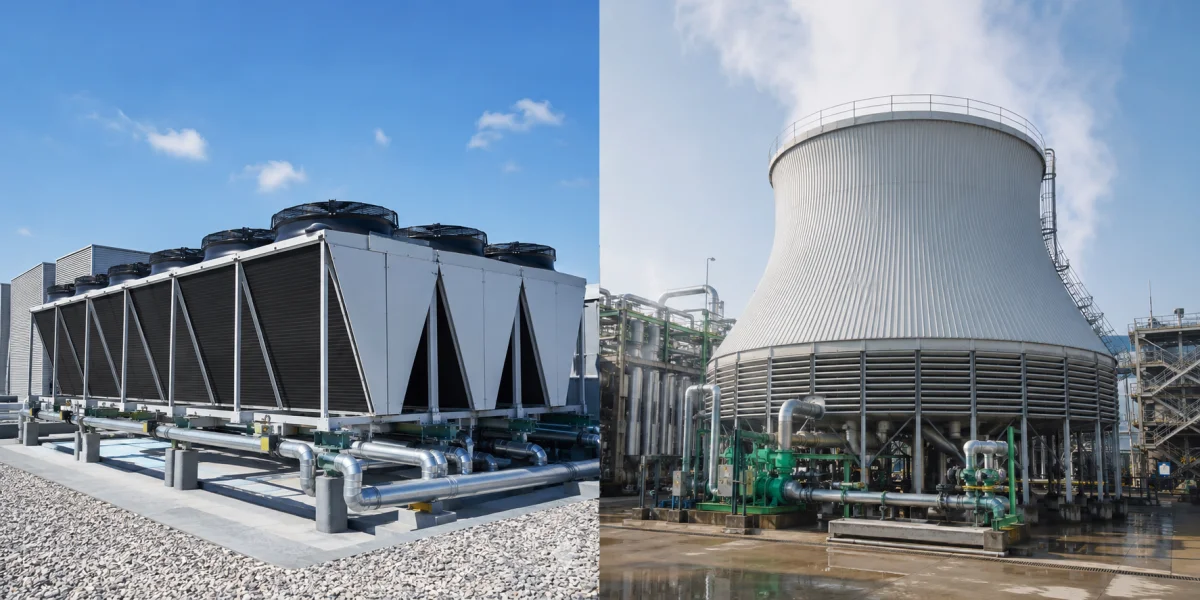
Dry cooler or cooling tower is a key choice when designing heat rejection for a chiller, compressor plant or industrial process. Both reject heat to outdoor air, but they use different principles. A dry cooler transfers heat through a closed coil without evaporating the process fluid, while a cooling tower uses air-water contact and evaporative cooling.
The choice affects leaving-water temperature, electricity, water consumption, maintenance, winter operation and site requirements. Neither solution is universally better. Selection depends on design temperatures, climate, water quality and the process operating profile.
How a dry cooler works
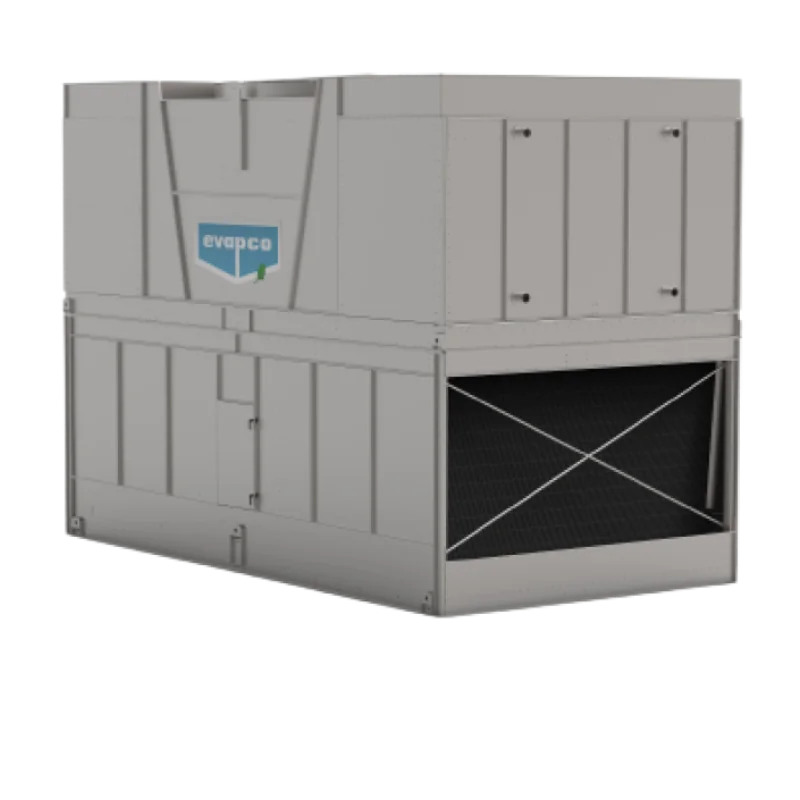
A dry cooler is a finned heat exchanger with fans. Water or glycol remains inside the tubes while outdoor air removes heat, keeping the circuit closed. Minimum fluid temperature is limited by outdoor dry-bulb temperature and the selected approach.
How a cooling tower works
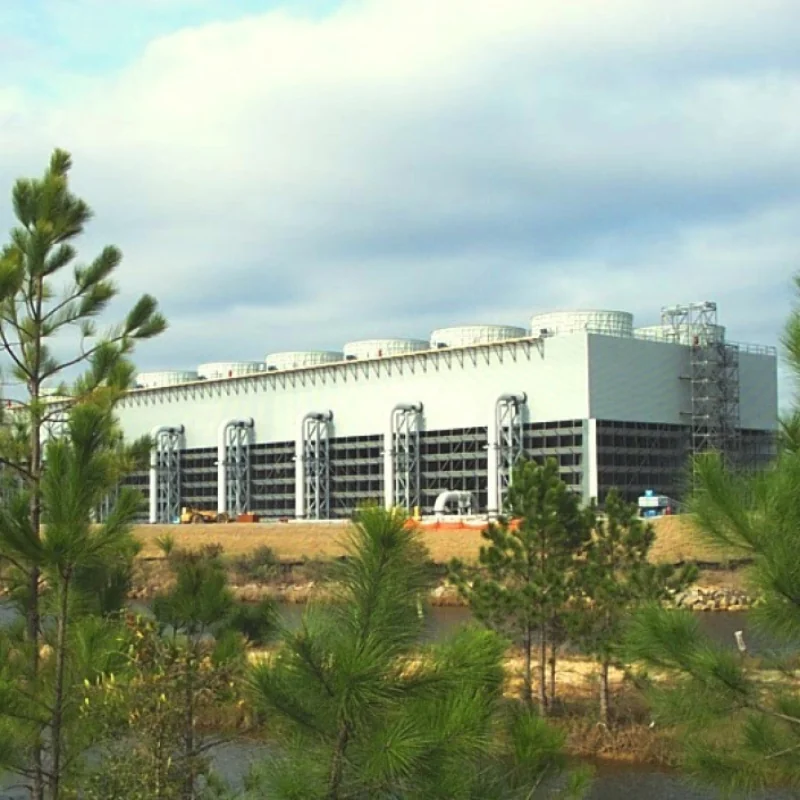
In an open cooling tower, warm water contacts moving air and a small portion evaporates, cooling the remaining flow. Water temperature can approach wet-bulb temperature. The benefit is lower summer temperature; the cost is makeup water, blowdown, treatment and hygienic maintenance.
Temperature capability
A dry cooler is selected against dry-bulb temperature, and a smaller approach requires a larger coil and more fan power. A cooling tower is selected against wet-bulb temperature and can produce colder summer water, which benefits water-cooled chillers and process systems.
Dry cooler and cooling tower comparison
| Parameter | Dry cooler | Cooling tower |
|---|---|---|
| Process-fluid contact with air | No | Yes in an open tower |
| Water evaporation | No | Yes |
| Temperature limit | Dry-bulb based | Wet-bulb based |
| Water treatment | Limited closed-loop treatment | Essential |
| Loop contamination risk | Low | Higher in an open system |
| Maintenance complexity | Lower | Higher |
Closed cooling circuit
A closed cooling circuit protects water or glycol from dust, oxygen and atmospheric contamination, reducing corrosion and scaling. This is valuable for data centers, lasers, compressors, furnaces and sensitive machine heat exchangers.
Process water cooling
For process water cooling, define supply temperature and permitted temperature rise. If water can remain above ambient, a dry cooler may be ideal. If summer water must be colder, use a cooling tower, hybrid unit or a dry cooler combined with a chiller.
Water consumption
A conventional dry cooler uses no water during normal operation. A cooling tower consumes water through evaporation, blowdown and drift. Lifecycle evaluation should include makeup water, treatment chemicals, drainage and maintenance.
Energy use
A dry cooler uses fans and pumps, with fan speed reduced in cold weather. A cooling tower also uses fans and pumps, but colder water can reduce chiller compressor energy. The entire system must be compared rather than one component.
Winter operation
In Kazakhstan, dry coolers use glycol, drainable coils or controlled circulation. Cooling towers require fan control, basin heating, icing management and bypass arrangements. Winter sequences must be designed and tested during commissioning.
Water quality and scaling
Cooling-tower evaporation concentrates dissolved solids, so blowdown and treatment are essential to prevent scale, corrosion and biological growth. A dry-cooler loop is easier to keep clean but still requires suitable fill water and corrosion control.
Maintenance
Dry-cooler service focuses on coil cleaning, fans, motors, sensors and hydronics. Cooling towers additionally require cleaning of the basin, nozzles, fill and drift eliminators, together with regular water-quality and hygiene control.
Industrial cooling system
An industrial cooling system may combine a dry cooler, cooling tower and chiller. The dry cooler provides free cooling in cold weather, while other equipment operates in summer. Hybrid systems can reduce annual cost but require coordinated controls.
Equipment selection criteria
Comparison begins with heat load and required temperatures. The designer then checks outdoor conditions, available water and power, site area, sound limits, redundancy and maintenance requirements. Stable part-load control is as important as peak capacity.
Installation and location
A dry cooler needs enough clearance to prevent hot discharge air from returning to the coil. Service access is required for fin cleaning and fan replacement. Roof installations must also consider structural load and vibration isolation.
A cooling tower additionally needs a basin or tank, makeup water, blowdown, drainage and safe management of discharge aerosol. It should not be placed close to ventilation air intakes without checking separation distances and prevailing wind.
Operating cost comparison
Lifecycle cost includes fan and pump electricity, water, treatment chemicals, cleaning, repair and downtime. A dry cooler is usually simpler to maintain, but high ambient temperature may require a larger coil or supplemental chiller capacity.
A cooling tower is more demanding to operate, yet colder condenser water can significantly reduce compressor energy in a large chiller plant. The correct economic choice comes from an annual calculation using local tariffs, climate data and the real load schedule.
Closed-circuit tower as a compromise
A closed-circuit tower keeps process fluid inside a coil while spray water evaporates outside. It suits applications needing a clean loop and lower temperature than a dry cooler can provide, but still requires makeup water, blowdown, treatment and winter protection.
Conclusion
When choosing a dry cooler or cooling tower, compare required water temperature, climate, water use, energy, maintenance and loop-contamination risk. A dry cooler is simpler and maintains a closed circuit, while a cooling tower achieves lower temperatures through evaporation. NIKLAND engineers calculate and design heat-rejection systems for chillers and industrial processes under Kazakhstan operating conditions.