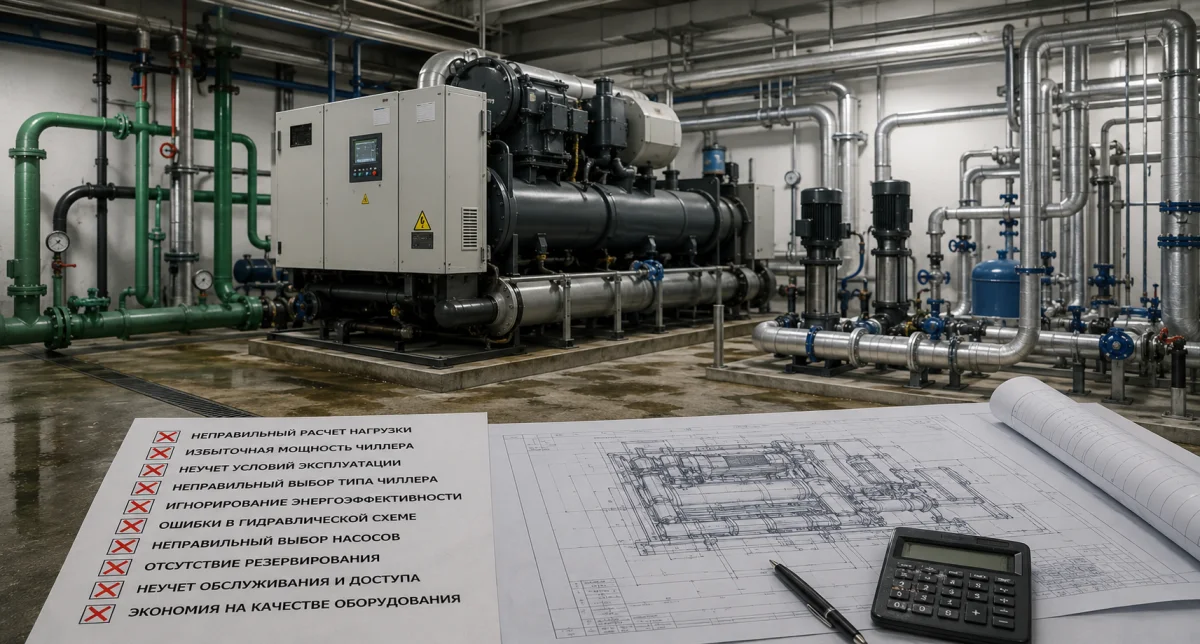
Mistakes when selecting a chiller usually result not from the machine itself, but from incorrect design information and weak system planning. A high-quality chiller may still operate poorly if capacity, hydraulics or placement are wrong. The result is unstable operation, frequent compressor starts, excessive energy use and insufficient cooling.
Correct selection begins with an analysis of the facility: room use, operating schedules, heat gains, ventilation, outdoor conditions, water temperatures and redundancy requirements. Only then should the designer choose the chiller type, compressors, number of circuits and connection arrangement.
Selecting capacity only by floor area
One of the most common mistakes is estimating cooling capacity from floor area using an average number of watts per square meter. This is suitable only for a preliminary estimate. It does not account for glazing, façade orientation, solar radiation, occupancy, lighting, servers, kitchens, process equipment or ventilation air.
An office, hotel, shopping center and factory with the same floor area can have very different loads. A complete cooling-system calculation must consider each zone, its schedule and load diversity.
Incorrect chiller capacity selection
Incorrect chiller selection can result in both insufficient and excessive capacity. An undersized machine cannot maintain the required water temperature during hot periods, runs continuously and fails to provide the design room conditions.
An oversized machine is also problematic. It reaches the setpoint quickly, stops and restarts shortly afterwards. Frequent cycling increases compressor wear, reduces temperature stability and lowers efficiency.
Oversized chiller capacity
An oversized chiller creates the greatest problems when the system water volume is small and minimum demand is low. If the machine cannot reduce output far enough, it begins operating in short cycles.
The solution may require a buffer tank, several chillers in cascade or equipment with a wider modulation range. Selection must consider minimum load as well as the design peak.
Wrong water-temperature schedule
Chiller performance depends directly on water temperature. The standard 7/12 °C schedule is not suitable for every application. Process cooling may require lower temperatures, while radiant cooling may use higher values.
As leaving-water temperature decreases, available cooling capacity and efficiency normally fall. If the design schedule is incorrect, the selected machine may not deliver its expected capacity.
Ignoring partial-load operation
For most of the season, a chiller operates below full load. Comparing machines only by nominal EER is therefore insufficient. Designers should evaluate IPLV, SEER, minimum output and compressor behavior at reduced demand.
For a facility with highly variable load, several chillers in cascade may perform better than one large machine. A modern inverter chiller may also have a wide modulation range, so the annual load profile should guide the final decision.
Hydraulic-calculation mistakes
Even a correctly sized chiller cannot operate without the required water flow. Low flow can cause freeze alarms, reduce heat transfer and prevent the machine from delivering design capacity. Excessive flow increases pressure loss and pump power.
Common causes include incorrect pipe diameters, poor balancing, dirty strainers, wrongly selected pumps and control valves. Variable-flow terminal systems must still maintain the minimum evaporator flow.
Insufficient system water volume
A chiller requires a minimum water volume for stable operation. In a short circuit, the water cools too quickly and the compressor stops. A few minutes later, temperature rises and the machine restarts.
A buffer tank is sized from minimum chiller capacity, acceptable cycle duration and water-temperature difference. A tank that is too small does not solve cycling, while an oversized tank occupies unnecessary space.
Chiller-plant design mistakes
Chiller-plant design includes more than placing equipment on a drawing. The plant room needs service clearances, routes for removing compressors and heat exchangers, ventilation, lighting, drainage, lifting provisions and safe access to electrical panels.
Doors and openings must allow major components to be replaced without damaging the building. Indoor chillers may also require heat-release checks, emergency ventilation and refrigerant-leak monitoring.
Incorrect air-cooled chiller placement
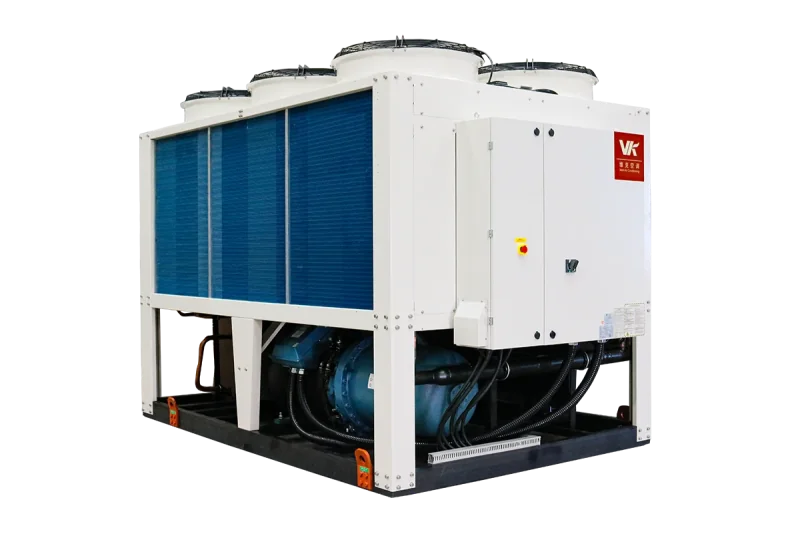
An air-cooled chiller needs unrestricted air intake and discharge. If it is installed in a deep recess, near a high parapet or too close to another machine, hot discharge air can return to the condenser.
This raises condensing pressure, reduces capacity and increases energy use. Roof installations must also account for wind, snow, sound, vibration, structural capacity and service access.
Chiller installation mistakes
Chiller installation can undermine a good design. Typical mistakes include missing vibration isolators, poor pipe supports, dirty water circuits, trapped air, incomplete insulation and incorrectly connected sensors.
Before startup, piping should be flushed, strainers cleaned, the circuit filled with treated water or glycol, air removed and actual flow verified. Construction debris and welding residue can quickly damage pumps and heat exchangers.
Glycol and water quality
Outdoor circuits may require glycol. Concentration is selected from the minimum design temperature. Too little glycol provides inadequate protection, while excessive concentration increases viscosity, pump load and reduces heat transfer.
After glycol is added, flow, pressure loss and heat-exchanger capacity must be recalculated. Water quality should also be controlled to prevent corrosion, deposits and clogged strainers.
No cooling redundancy
For data centers, healthcare facilities and continuous production sites, one chiller without backup creates a major risk. An N+1 arrangement or several machines sharing the load are commonly used.
Redundancy must include pumps, electrical supply and controls as well as the chiller. Otherwise, the standby unit may not start automatically after a failure.
Skipping commissioning
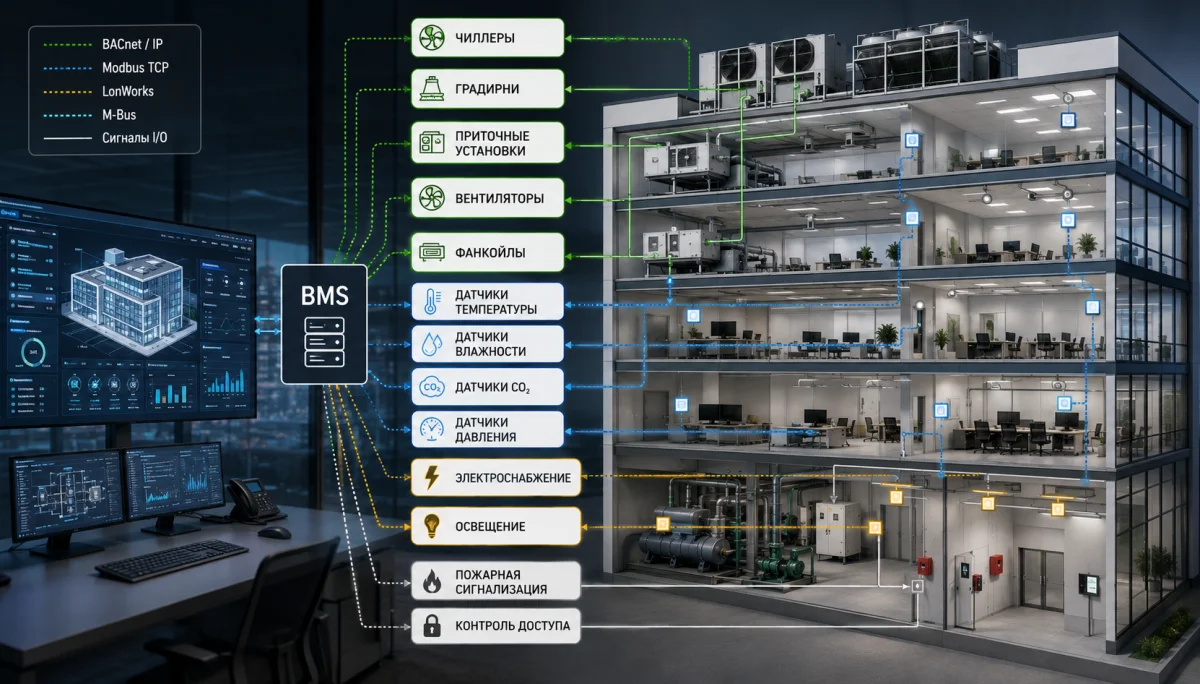
The system should not be considered complete immediately after installation. Commissioning verifies flow rates, temperatures, pressures, safeties, pumps, valves, compressors and BMS communication.
Measured values are compared with the design. A very small water-temperature difference may indicate excessive flow, while a large difference may indicate insufficient flow. Without commissioning, a system can waste energy for years.
Common signs of incorrect selection
- frequent compressor starts and stops;
- continuous operation at maximum capacity;
- water temperature does not remain near setpoint;
- supply-to-return temperature difference is incorrect;
- low-flow or freeze alarms occur;
- summer condensing pressure is too high;
- pump power exceeds the design value;
- rooms cool unevenly.
Conclusion
Mistakes when selecting a chiller occur when the machine is considered separately from the building, hydraulics, controls and actual operating profile. A correct project begins with heat-load calculations and the water-temperature schedule, followed by checks of minimum load, water flow, placement, redundancy and service access. NIKLAND engineers calculate cooling systems, select air-cooled and water-cooled chillers, design chiller plants and support installation and commissioning.