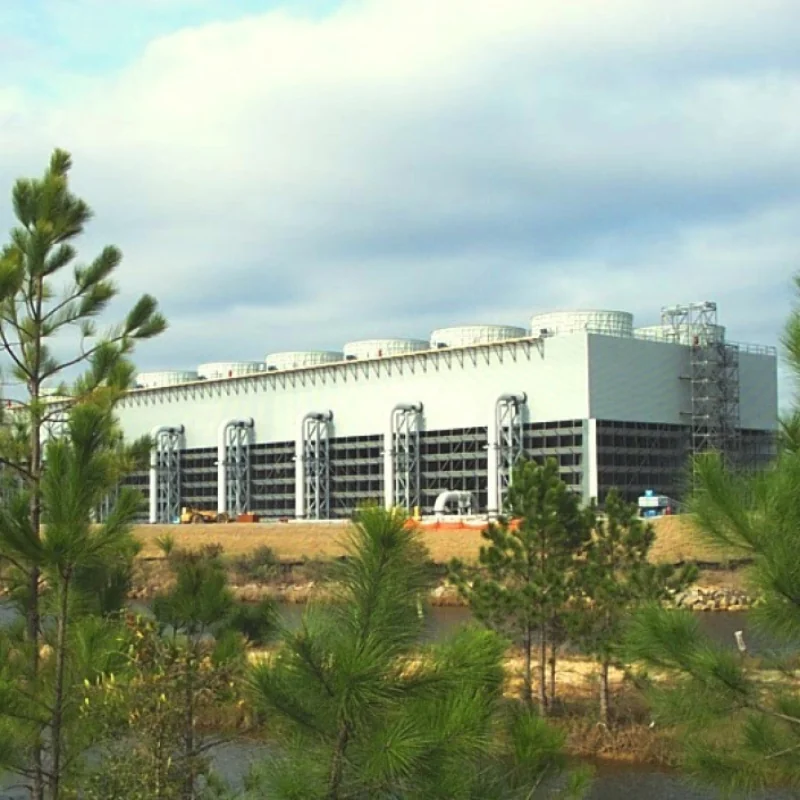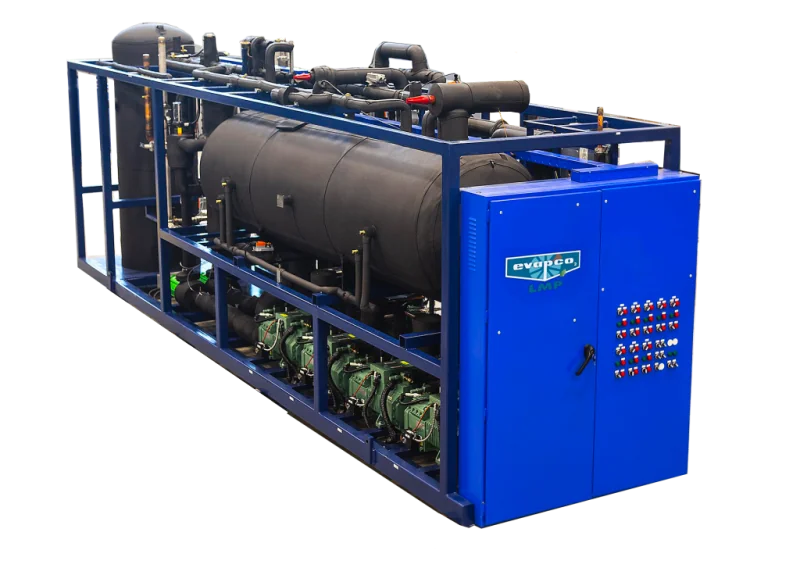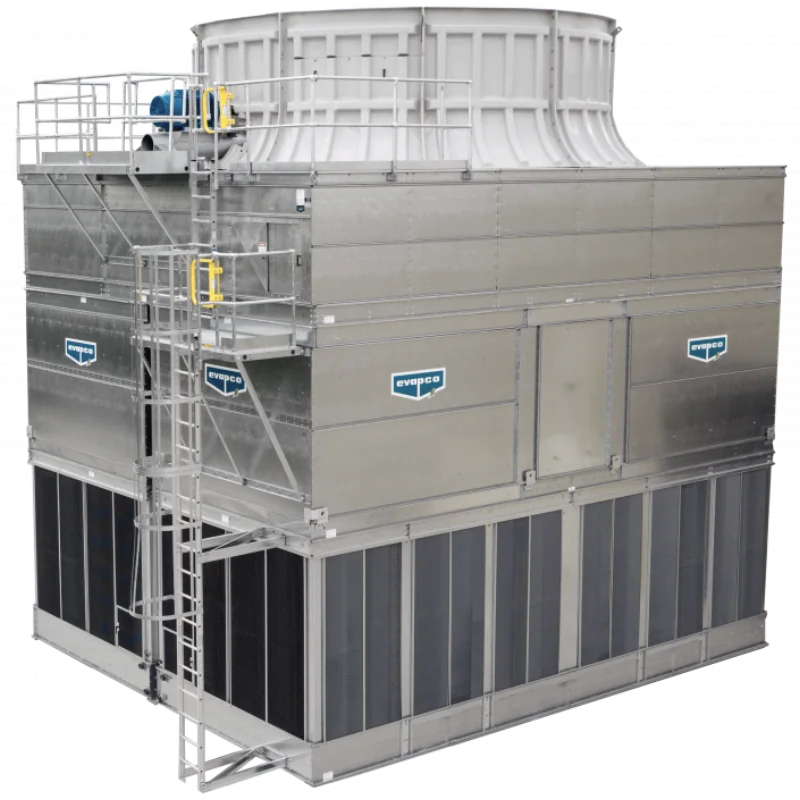
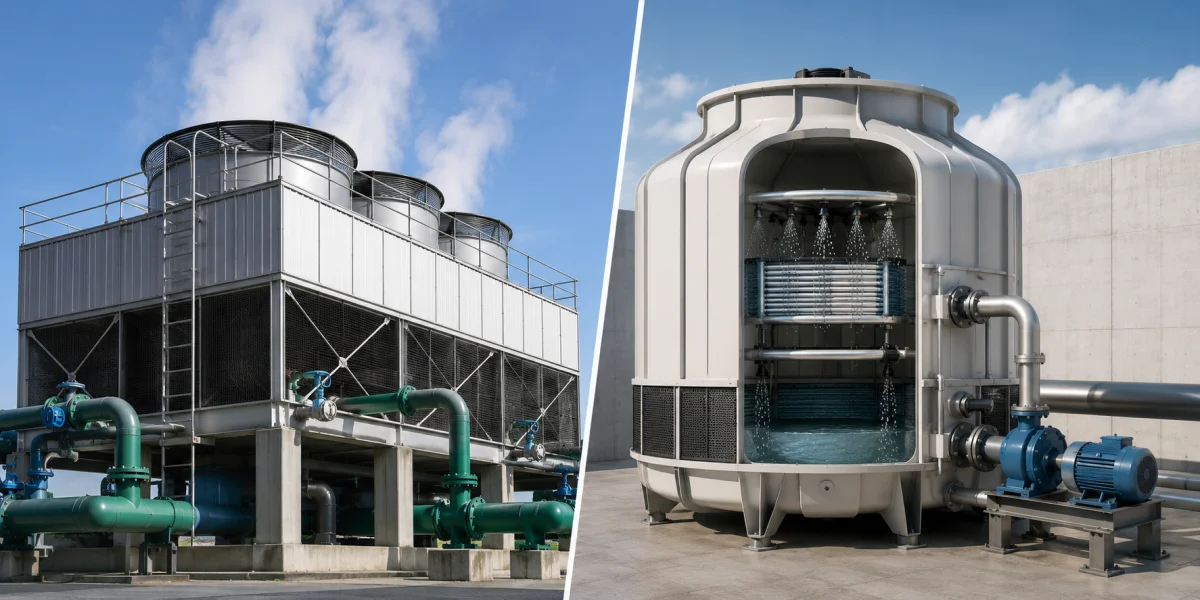
Open or closed-circuit cooling tower is a major design choice for heat rejection from chillers, industrial equipment and process systems. Both use evaporative cooling, but they interact with the heat-transfer fluid differently. The choice affects efficiency, water quality, maintenance, cost and winter reliability.
An open tower is generally less expensive and more compact for the same duty. A closed-circuit tower protects the primary fluid from outdoor contamination but includes an additional heat exchanger and usually costs more. Selection depends on process requirements, temperature conditions, water quality and operating mode.
How an open cooling tower works
An open cooling tower receives warm water from a condenser or process circuit. Nozzles distribute it over fill while a fan moves outdoor air through the tower. A small portion evaporates and the remaining water cools before collecting in the basin.
The cooled water returns directly to the chiller or equipment. Because it contacts air, dust, organic material and dissolved substances enter the circuit. Evaporation concentrates salts, so make-up water, blowdown, filtration and water treatment are required.
How a closed-circuit tower works
A closed-circuit cooling tower contains a heat-exchanger coil. The primary fluid circulates inside the tubes and does not contact outdoor air. Spray water wets the outside of the coil while airflow provides evaporative cooling.
The primary circuit stays clean and may contain treated water or a water-glycol mixture. The external spray circuit still requires basin, nozzle and coil-surface cleaning and suitable water treatment.
The main difference
In an open system, the same water passes through the tower and connected equipment. In a closed system, the process fluid is separated from outdoor air by the coil wall. This protects chillers or process machines from contamination but creates additional thermal resistance.
For the same outdoor condition, an open tower may deliver a lower water temperature or require less surface area. A closed tower needs an additional temperature difference across the coil.
Cooling tower comparison
| Parameter | Open | Closed |
|---|---|---|
| Primary fluid contacts outdoor air | Yes | No |
| Primary fluid contamination | Higher | Lower |
| Initial equipment cost | Usually lower | Usually higher |
| Thermal efficiency | Higher | Lower because of coil |
| Use of glycol | Limited | Practical |
| Maintenance focus | Complete circuit | External spray circuit |
Advantages of an open tower
- high evaporative cooling efficiency;
- smaller size and weight for similar duty;
- lower equipment cost;
- simple construction without an intermediate coil;
- good suitability for large water-cooled chillers.
An open system is attractive where circulating-water quality can be controlled and the connected equipment is designed for an open condenser-water circuit.
Limitations of an open tower
The main limitation is contamination of the complete system. Scale may form in pipes, chiller condensers, strainers and valves. Poor water chemistry reduces heat transfer, raises condensing pressure and increases energy consumption.
Open systems also need regular blowdown, cleaning and biological control. In winter, basins, pipes, nozzles and fill must be protected from freezing.
Advantages of a closed tower
- clean primary heat-transfer circuit;
- less fouling in chillers and process equipment;
- practical use of glycol;
- stable primary-circuit hydraulics;
- good suitability for sensitive equipment.
Closed towers are often used for data centers, compressors, furnaces, lasers, machine tools and processes where fouling can cause expensive downtime.
Limitations of a closed tower
Closed-circuit equipment is usually more expensive, heavier and larger. The coil adds thermal resistance and pressure loss, so the primary pump must overcome the heat-exchanger resistance.
Deposits on the outside of the coil also reduce capacity. A closed tower does not eliminate treatment and maintenance; it moves the main contamination risk to the external spray circuit.
Water use and treatment
Both tower types consume water through evaporation, blowdown and drift. A closed tower is not water-free. Consumption depends on heat load, outdoor conditions, water quality and cycles of concentration.
In an open system, water chemistry affects the complete circuit. In a closed system, the primary fluid can remain stable, but basin and spray water still require scale, corrosion and biological control.
Winter operation in Kazakhstan
Industrial cooling tower selection must account for sub-zero design temperatures. Open towers require protection of basins, piping, nozzles and fill, with fan staging and cell control at low load.
A closed tower may use glycol in the primary circuit, but the spray loop can still freeze. During long shutdowns it is drained, and basin heating or heat tracing may be required. Dry winter operation must be confirmed by manufacturer calculations.
How to choose
A proper cooling tower comparison begins with whether the primary fluid may contact outdoor air. When contamination is acceptable and high efficiency and lower cost are priorities, an open tower is often preferred. When equipment is sensitive or glycol is required, a closed tower may be more reliable.
The designer also checks thermal duty, entering and leaving temperatures, climate, available space, sound, water use, electrical demand, redundancy and winter operation. Lifecycle cost should include pumps, treatment, cleaning and the potential cost of downtime.
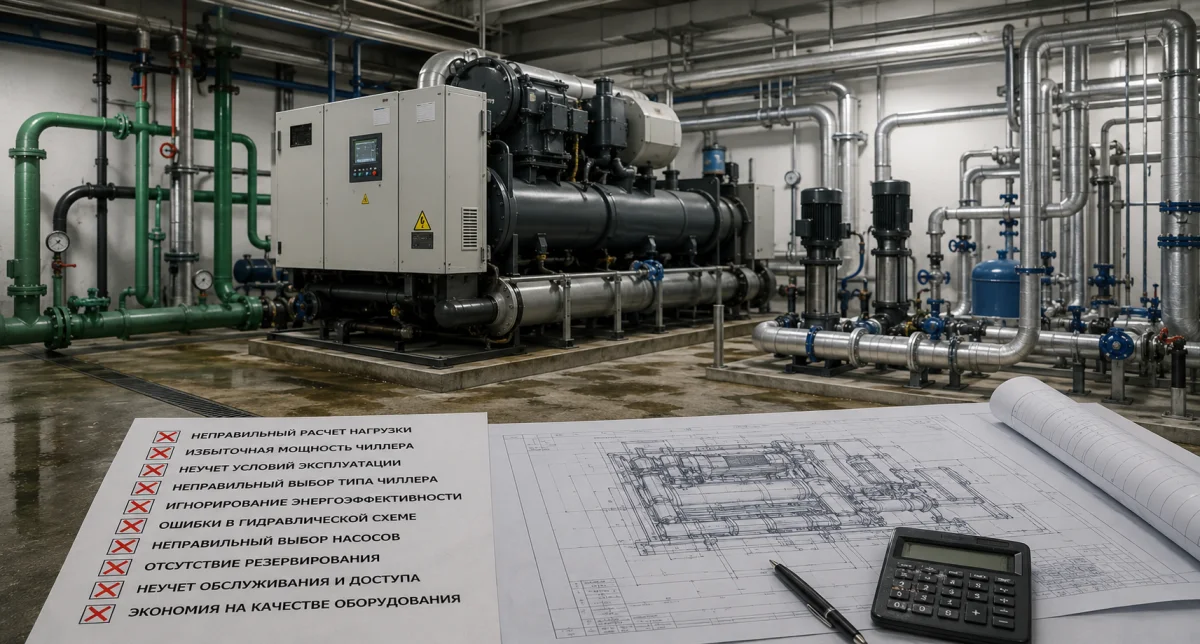
Common mistakes
- selecting only by purchase price;
- ignoring source-water quality;
- comparing capacities at different design conditions;
- providing no access to basin, nozzles or coil;
- failing to design winter operation and drainage;
- underestimating sound and moist-air recirculation;
- providing no standby capacity for a critical process.
Conclusion
The choice between an open or closed-circuit cooling tower depends on the primary system. Open towers are efficient and economical but expose the complete circuit to contamination. Closed towers protect process fluid and suit glycol and sensitive equipment, but include an additional heat exchanger and higher cost. NIKLAND engineers calculate and select cooling towers according to duty, water quality, Kazakhstan climate and facility operating requirements.