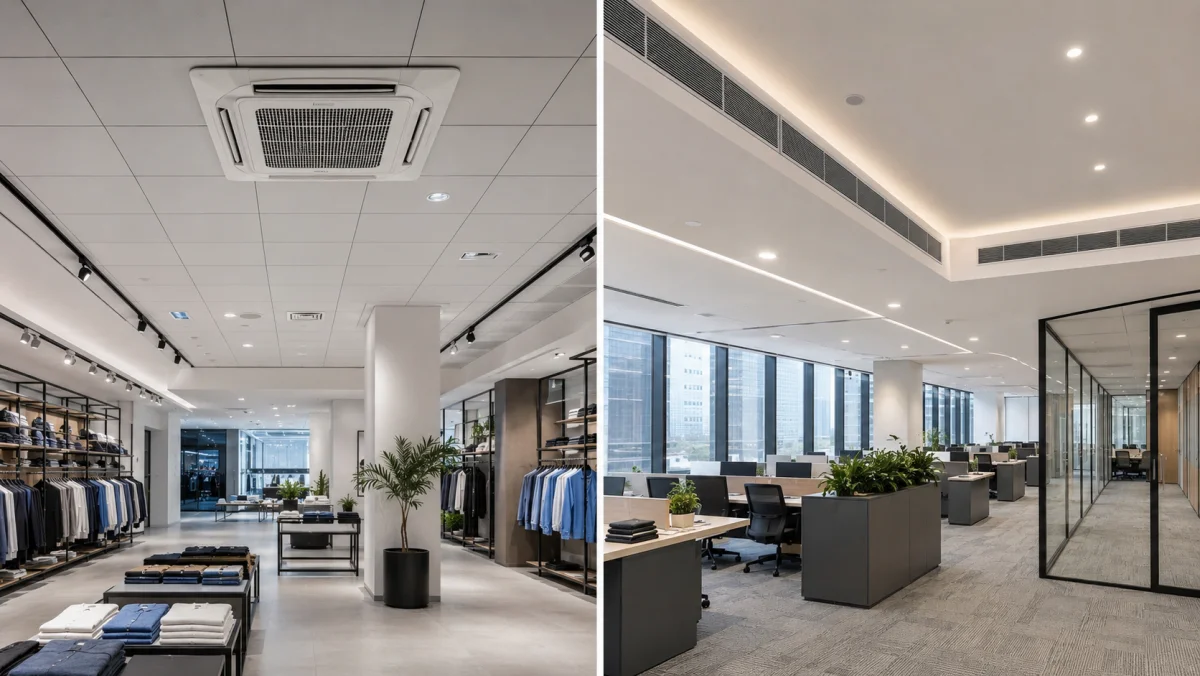
Cassette or ducted air conditioner is a common choice for offices, shops, restaurants, clinics and other commercial spaces. Both indoor-unit types can be installed above a ceiling, but they differ in air distribution, installation complexity, appearance, sound and zoning capability.
A cassette unit supplies air through a visible ceiling panel, usually in four directions. A ducted unit is fully concealed and connects to the room through ducts, grilles and diffusers. The correct choice depends on layout, ceiling height, interior design and operating requirements rather than capacity alone.
How a cassette air conditioner works
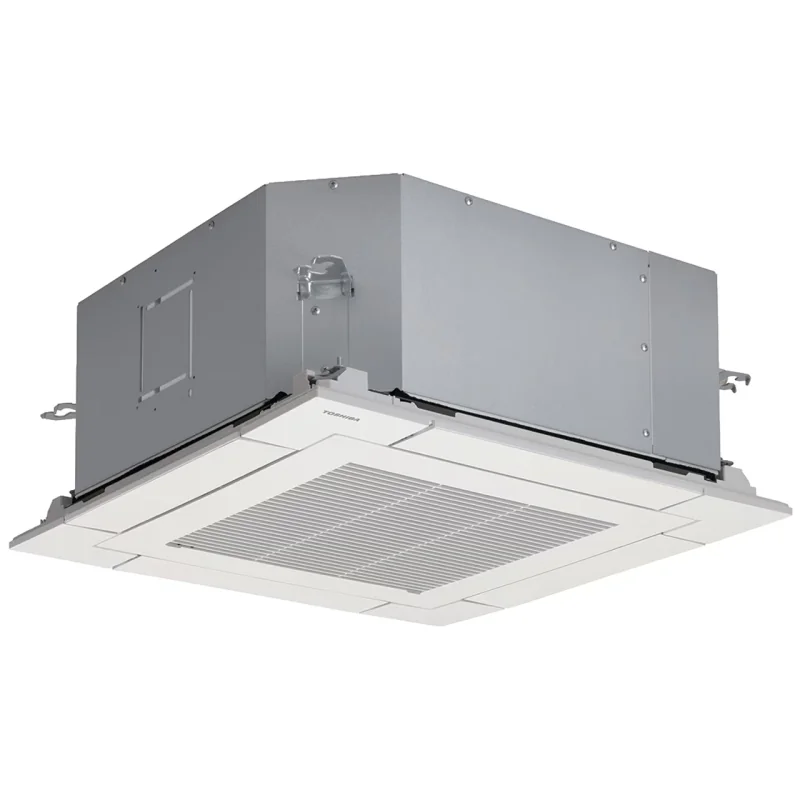
The cassette body is installed above the suspended ceiling while only the decorative panel remains visible. Return air enters through the center, passes through a filter and coil and is discharged through the panel outlets.
Four-way cassettes are most common, although one-way, two-way and compact models are also available. They suit open rooms with enough ceiling space for the unit, drain connection and maintenance.
How a ducted air conditioner works
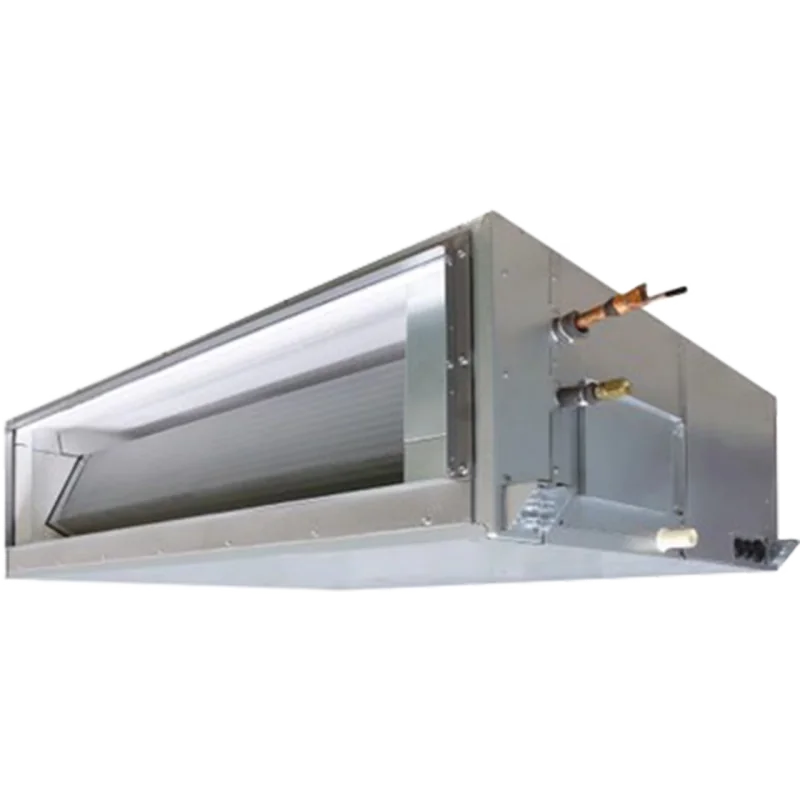
A ducted indoor unit is completely hidden above the ceiling or in a technical area. Supply air travels through ducts to grilles or diffusers. Return air reaches the unit through a dedicated grille and duct or an approved ceiling-plenum arrangement.
This arrangement allows several supply points and better adaptation to irregular room geometry. It also requires duct-pressure calculation, correct external static pressure and sufficient ceiling space.
Cassette and ducted comparison
| Parameter | Cassette | Ducted |
|---|---|---|
| Appearance | Visible ceiling panel | Only grilles are visible |
| Air supply | Several directions from one point | Through a duct network |
| Installation | Simpler | More complex |
| Zoning | Normally one zone | Several zones are possible |
| Ceiling space | Space for unit and drain | Space for unit, ducts and accessories |
| Maintenance | Through the panel | Through access panels |
Air distribution
A cassette works well in an open office, retail hall or waiting area. Air spreads from a central point and mixes across the room. With correct positioning, one unit can serve a large open zone.
A ducted system allows outlets to be positioned along glazing, displays, workstations or circulation routes. This gives more flexibility, but poor design can create noise, drafts and uneven temperatures.
Air conditioner for an office
An air conditioner for an office should match the layout. A cassette is usually simpler and less expensive for an open-plan office with fairly uniform loads. It requires no long duct network and is easy to service through the panel.
For private offices, meeting rooms and irregular spaces, a ducted unit may offer better outlet placement. However, one ducted unit cannot provide independent room temperatures without motorized dampers, separate sensors and zoning controls.
Air conditioner for a shop
An air conditioner for a shop must account for visitors, lighting, display equipment, refrigeration and entrance doors. Cassette units work well in open retail areas with modular suspended ceilings.
A ducted system suits boutiques and designer interiors where equipment should remain hidden. Linear diffusers and compact grilles can be integrated more easily and used to supply air along shopfront glazing.
Ceiling requirements
A cassette requires enough depth for the casing, drainage and service access. Dimensions should be checked before ceiling construction. Insufficient space may force a lower finished ceiling.
A ducted arrangement needs additional space for ducts, transitions, attenuators and dampers. Higher airflow and more outlets require larger ducts, so clear room height must be coordinated with the HVAC design.
Sound level
A cassette is located directly above the occupied zone, so fan sound is present in the room. Modern units can be quiet at low speed, but sound rises at maximum airflow.
A ducted unit can be installed farther from workstations and combined with an attenuator. However, excessive duct velocity or undersized grilles will create aerodynamic noise. Quiet operation depends on design as much as on unit data.
Outdoor air and ventilation
Neither a cassette nor a standard ducted air conditioner replaces mechanical ventilation. Both mainly recirculate indoor air. Some models allow limited outdoor-air connection, but this is often insufficient for the required air exchange.
A proper commercial-space climate system includes a separate supply and extract calculation. Ventilation delivers outdoor air, while air conditioners remove room heat.
Zoning
A cassette normally serves one open zone. Separate rooms use separate indoor units, which makes independent temperature control straightforward.
A ducted unit can serve several rooms, but one thermostat cannot represent every zone. Independent control requires motorized dampers, separate sensors, bypass arrangements and a coordinated control sequence.
When a cassette is better
- open office or retail hall;
- standard suspended ceiling;
- one temperature zone;
- priority on simple installation and service;
- a visible ceiling panel is acceptable.
When a ducted unit is better
- irregular room geometry;
- the indoor unit must be hidden;
- several supply-air locations are required;
- air must be delivered along glazing or displays;
- adequate ceiling space is available;
- zoning controls are included.
Common mistakes
- selecting only by cooling capacity;
- placing a cassette beside a partition or above a workstation;
- designing ducts without pressure and velocity calculations;
- providing no maintenance access;
- treating air conditioning as ventilation;
- serving separate offices without zoning controls;
- ignoring drainage and ceiling depth.
Conclusion
There is no universal winner in the choice of cassette or ducted air conditioner. A cassette is simpler, less expensive and effective in open commercial spaces. A ducted unit provides concealed installation and flexible air distribution but requires more ceiling space and careful design. NIKLAND engineers select climate systems for offices, shops and commercial facilities according to room loads, layout, ventilation and interior requirements.