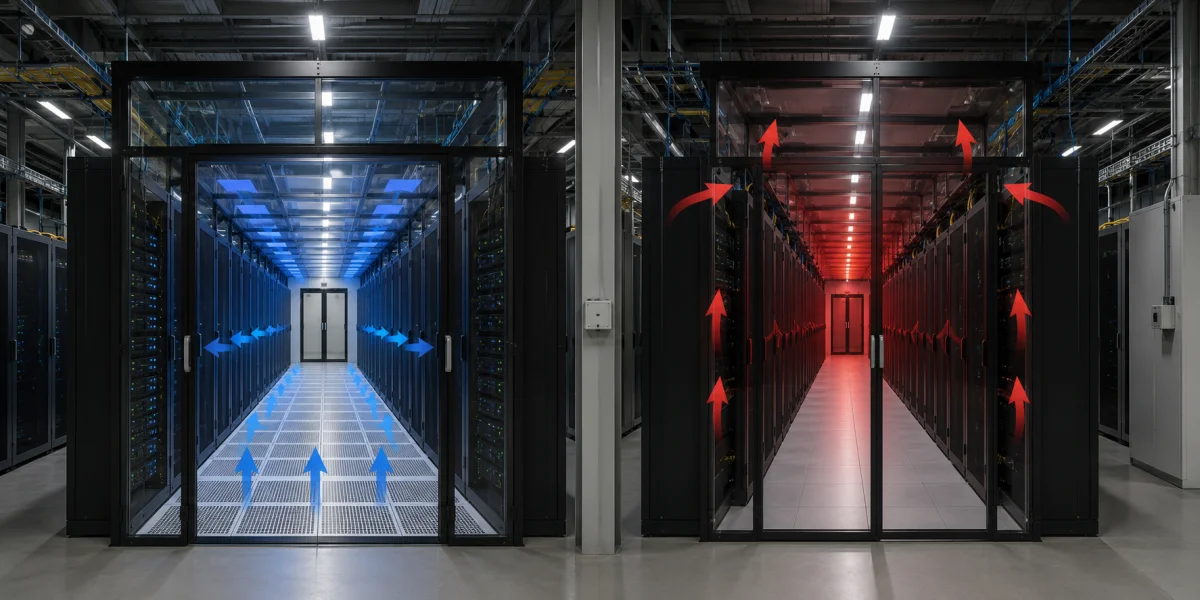
Cold and hot aisles in a data center are created by placing rack fronts together and rack rears in a separate exhaust zone. Cold air reaches server inlets, while heated air returns separately to the cooling system.
This arrangement reduces mixing and hot spots. Effective operation also requires sealed openings, blanking panels and sufficient airflow through each rack.
How the cold aisle works
The cold aisle lies between rack fronts. Air may enter through floor tiles, ceiling diffusers, ducts or in-row units. Temperature should remain stable along the aisle and rack height; warmer upper inlets indicate poor distribution or hot-air mixing.
What the hot aisle is
The hot aisle lies between rack rears. Heated air returns to precision cooling units, a ceiling plenum or exhaust ducts. A high temperature is acceptable when the flow cannot recirculate to server inlets and may improve heat-exchanger performance.
Why air mixing causes problems
Hot-air recirculation raises server inlet temperature, fan speed, sound and failure risk. Cold-air bypass sends conditioned air back to cooling units without passing through IT equipment, so the unit sees a low return temperature even while racks overheat.
Cold aisle containment
Cold aisle containment encloses supply air with doors, roof panels and side barriers, forcing it through servers. Fire protection, personnel access and gas suppression must be coordinated, and pressure should remain slightly positive without excessive leakage.
Hot aisle containment
Hot aisle containment directs rack exhaust to the cooling return or ceiling plenum while the room remains cooler. It works well with overhead return and in-row cooling, provided joints are sealed and the exhaust path remains unrestricted.
Which containment method to choose
Selection depends on cooling architecture, ceiling, raised floor and unit location. Cold containment often suits floor supply, while hot containment works well with overhead return. Live facilities also require phased installation without interrupting IT operation.
Data center airflow
Data center airflow must match rack power. Insufficient supply causes recirculation, while excessive supply causes bypass. Airflow is estimated from heat load and permitted temperature rise, so racks with different density require individual balancing.
Server rack cooling
Server rack cooling is based on actual power and growth allowance. A 5 kW rack and a 25 kW rack need different airflow. High-density rows may use in-row units, rear-door heat exchangers or liquid cooling, especially where upper rack positions overheat.
Aisle sealing
Aisle sealing includes blanking panels, brush grommets and closure panels between racks. Small openings create significant mixing at high airflow. Smoke tests or measurements should verify direction and reveal hidden leakage.
Eliminating server overheating
Eliminating server overheating starts with inlet-temperature and airflow measurements. Blanking panels, tile relocation, obstruction removal or balancing often solve local faults. A heavily loaded rack may require dedicated in-row or liquid cooling.
Temperature and pressure monitoring
Rack inlet temperatures are measured at several heights, with additional sensors in hot aisles and return air. Differential pressure shows whether supply is adequate: excess pressure increases leakage, while low pressure allows recirculation. BMS or DCIM records trends.
Energy efficiency
Airflow separation allows higher supply temperatures, better chiller efficiency and more free-cooling hours. Containment must be followed by balancing and revised setpoints; otherwise much of the potential saving remains unrealized.
Airflow audit
Before design or modernization, the data hall should be audited. Engineers record rack power, inlet and exhaust temperatures, fan speed, cooling-unit location, perforated tiles and cable openings. The measurements are used to map hot spots, recirculation paths and cold-air bypass.
Total cooling-unit airflow is then compared with server demand. When supply greatly exceeds rack demand, air bypasses IT equipment. When supply is too low, racks pull heated air from the room. Dampers, fan speeds and floor-tile positions are corrected from measured results rather than estimates alone.
Airflow calculation from rack load
Required airflow is related to rack heat output and the permitted temperature rise through the servers. Higher power and a smaller temperature difference require more air. Calculations should be completed for each row and for the highest-density racks rather than using only an average hall value.
Failure conditions must also be checked. In an N+1 arrangement, the remaining cooling equipment should maintain acceptable server inlet temperatures after one unit stops, without causing major changes in aisle pressure or airflow direction.
Commissioning after containment
After doors, roof panels and blanking elements are installed, temperatures and pressure are measured again. Floor tiles and dampers are balanced, emergency modes are tested and cooling controls are adjusted. Supply-air setpoints can then be raised gradually while the hottest rack inlets are monitored.
Final inlet temperatures, aisle pressure, cooling-unit load and fan speeds should be recorded as a baseline. These values make it easier to detect deterioration after new servers are installed or rack density changes.
Common mistakes
- racks facing inconsistent directions;
- missing blanking panels in unused rack spaces;
- perforated tiles installed in hot aisles;
- unsealed cable openings and rack gaps;
- equal airflow assigned to racks with different loads;
- temperature measured only near cooling units;
- lowering setpoints instead of correcting airflow mixing.
Conclusion
Cold and hot aisles in a data center separate supply and return air, reduce mixing and improve cooling efficiency. Rack arrangement alone is not sufficient: containment, sealing, balancing and continuous temperature monitoring are required. NIKLAND designs and upgrades data center cooling systems according to rack density, redundancy, airflow and Kazakhstan climate conditions.