Liquid cooling for servers is becoming a key technology in data centers where processor, accelerator and rack power continue to rise. Conventional air cooling is limited by the amount of heat that can be moved safely through the white space and air-conditioning equipment. With AI, machine-learning and high-performance computing loads, airflow, noise and temperature can quickly reach practical limits.
Liquid has a much higher heat-carrying capability than air and can remove heat directly from processors, graphics accelerators, memory and other high-load components. This reduces dependence on very large airflow, limits local hot spots and allows more computing capacity in each rack. The system still requires detailed engineering, coolant-quality control, leak protection and coordination between IT and mechanical infrastructure.
Why air cooling reaches its limits
A conventional server draws cool air through the front and discharges heated air at the rear. As rack power increases, the facility needs more airflow, larger fans and greater cooling capacity. Air velocity, noise, fan energy and the difficulty of delivering equal airflow to every server all increase.
Cold- and hot-aisle containment remains effective at low and medium density. However, high-density rack cooling becomes difficult when several GPU servers release tens of kilowatts within a small volume. Even when total room capacity is sufficient, individual components may overheat because of recirculation or inadequate airflow through a particular chassis.
What is data center liquid cooling?
Data center liquid cooling transfers IT heat to a coolant circulating between server heat exchangers, distribution equipment and the facility heat-rejection loop. It may remove most of the load or supplement air cooling: processors and accelerators connect to liquid while power supplies and drives remain air cooled.
Direct liquid cooling
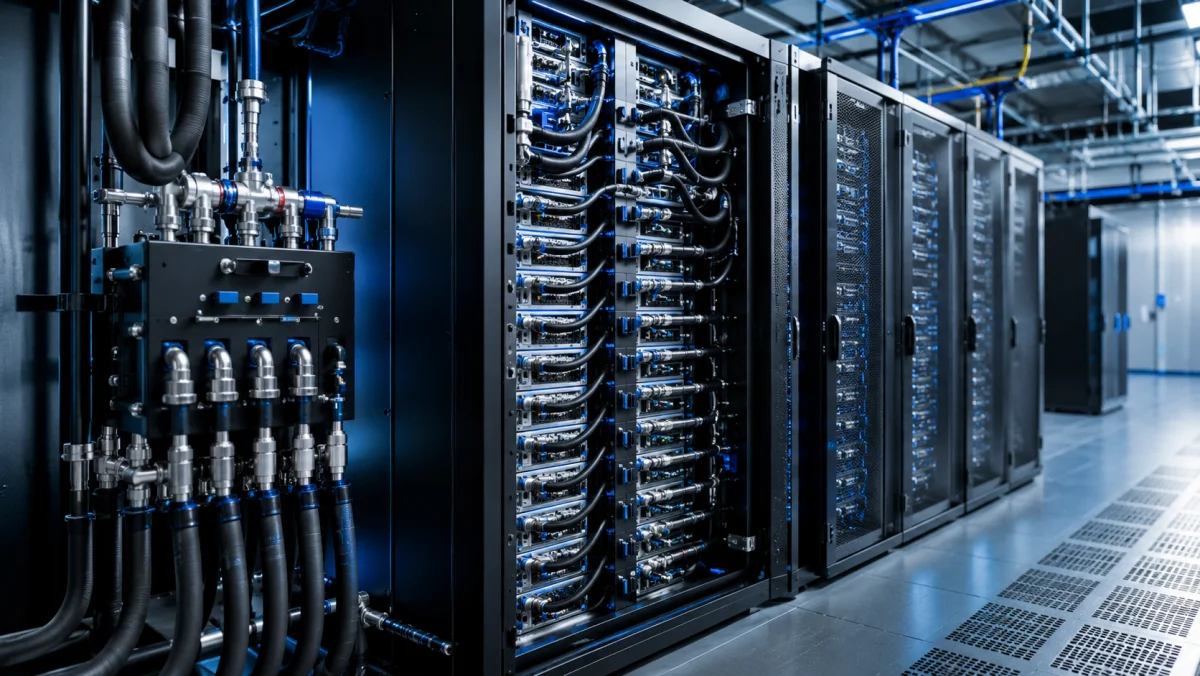
Direct liquid cooling delivers coolant to cold plates mounted on processors and accelerators. Heat passes through the metal plate into the liquid and is then transported to a coolant distribution unit and the external water loop.
The main advantage is that heat is collected directly at the dominant source instead of first entering the room air. The servers can retain a familiar rack format but require factory-approved cold plates, tubing and dripless connectors. Compatibility with the server warranty and maintenance procedures must be confirmed.
What is a data center CDU?
A CDU for a data center is a coolant distribution unit that manages and separates the facility water loop from the technology loop serving the servers. It maintains the required supply temperature, pressure and flow and protects IT equipment from contamination or unstable conditions in the building network.
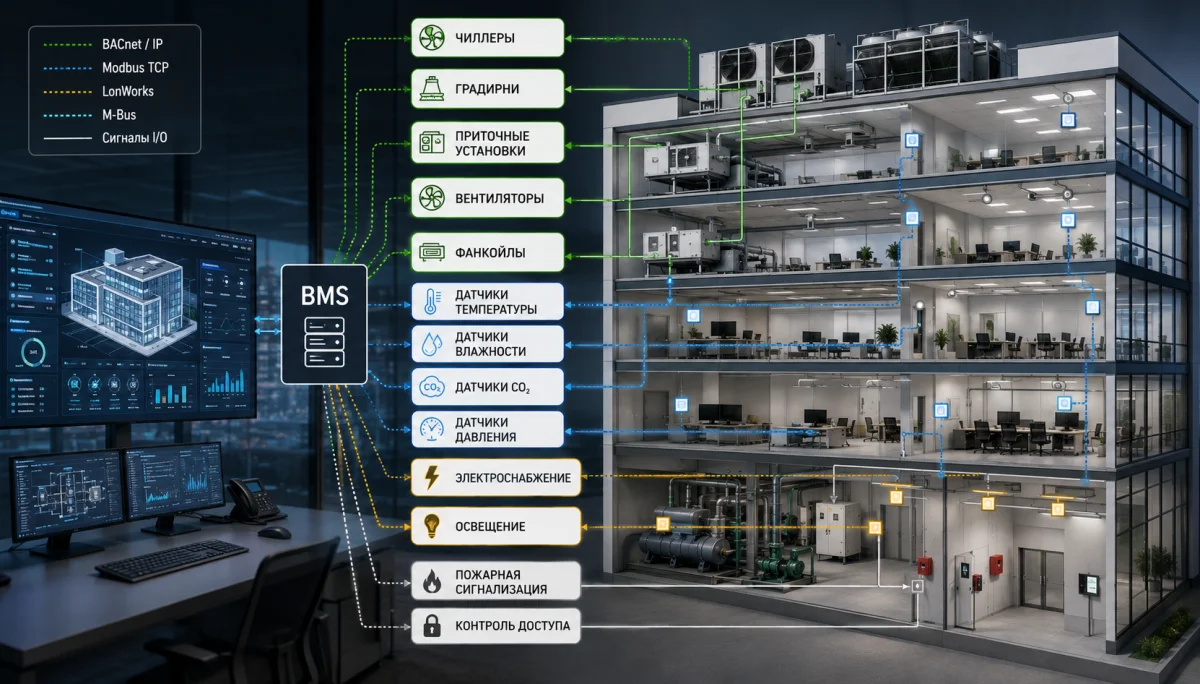
A CDU commonly includes a heat exchanger, pumps, filters, expansion volume, sensors and controls. It monitors supply and return temperature, pressure, flow and leakage. Critical systems may use redundant pumps, dual power inputs and integration with the building management system.
How the system is arranged
- a chiller, dry cooler or cooling-tower loop supplies cooling to the CDU;
- the CDU heat exchanger separates facility water from the server coolant;
- pumps deliver coolant through distribution manifolds to the racks;
- rack piping connects individual servers and cold plates;
- warm coolant returns to the CDU and transfers heat to the facility loop;
- controls monitor flow, temperature, pressure and alarm conditions.
The architecture may be centralized, with one CDU serving several racks, or distributed with units assigned to a row or individual rack. Selection depends on capacity, distance, redundancy and the acceptable coolant volume inside the data hall.
Cooling AI servers
Cooling AI servers requires particular attention because GPU power and module density are high. A single rack can exceed the practical capacity of standard air cooling. Server manufacturers increasingly offer systems designed for connection to direct liquid cooling.
Designers must consider not only total rack power but also the percentage transferred to liquid. Cold plates may remove most processor and accelerator heat, while the remaining load still enters the room air. Precision air conditioners or rear-door heat exchangers must therefore cover the residual heat.
Reliability and leak protection
Systems use dripless connectors, secondary loops, leak sensors, drip trays and automatic isolation of a damaged branch. Joints remain accessible for inspection. Coolant chemistry, corrosion, contamination and material compatibility must also be controlled because unsuitable water can damage cold plates, filters and pumps without an external leak.
When liquid cooling is justified
- rack power exceeds the capacity of the existing air system;
- the data center hosts GPU servers, AI clusters or HPC equipment;
- computing density must increase without adding floor area;
- fan airflow and energy use need to be reduced;
- a facility loop can accept heat at the required temperature;
- the operations team can support liquid-cooling infrastructure.
What to verify before implementation
The project begins with a heat balance for every rack, including the liquid-cooled share, residual air load, supply and return temperatures and future expansion. Engineers calculate flow, pressure loss, pumps, heat exchangers, piping and redundancy and check floor loading, CDU location, pipe routes, power, drainage, BMS integration and staged installation without interrupting active servers.
Conclusion
Liquid cooling for servers removes heat efficiently from high-density racks, AI servers and HPC systems when air cooling approaches its limits. Direct liquid cooling retains the familiar rack format, while the CDU separates and controls the coolant loops. Successful deployment requires accurate calculations, coolant management, leak protection and redundancy. NIKLAND engineers design liquid and hybrid data center cooling around IT power, existing infrastructure and availability requirements.