Cooling tower water treatment protects heat exchangers, pumps, piping and the tower from scale, corrosion, biological growth and suspended solids. In an open recirculating circuit, water evaporates while dissolved minerals remain and become more concentrated. Without control, heat transfer falls, energy use rises and equipment reliability deteriorates.
A complete program includes source-water analysis, makeup treatment, chemical dosing, filtration, conductivity control, automatic blowdown and laboratory monitoring. The equipment arrangement depends on water quality, heat load, system materials and operating schedule.
Why tower water becomes concentrated
Evaporation removes water and heat, but calcium, magnesium, chlorides, sulfates and other dissolved substances remain in the circuit. Their concentration therefore becomes higher than in the incoming makeup water. Dust, sand, organic material and microorganisms also enter from outdoor air.
Without blowdown and treatment, circulating water can become scaling, corrosive or biologically active. Visual appearance alone is not a reliable indication of water quality.
Makeup-water requirements
Makeup water replaces evaporation, drift and blowdown losses. Before design, it should be tested for hardness, alkalinity, pH, conductivity, iron, silica, chlorides, sulfates, suspended solids and organic contamination.
Municipal, borehole and surface water require different preparation. Treatment is selected from laboratory results and equipment limits rather than hardness alone.
Scale and corrosion
Scale forms when dissolved minerals precipitate on warm surfaces. Even a thin layer reduces heat transfer, raises condensing temperature and increases refrigeration energy use.
Corrosion damages piping, heat exchangers and metal tower components. Its rate depends on pH, oxygen, dissolved salts, temperature, flow velocity and material combinations. A treatment program must therefore control both deposits and water aggressiveness.
Water softening
Water softening reduces calcium and magnesium that contribute to carbonate scale. Automatic ion-exchange softeners regenerated with salt are commonly used.
Softening does not remove all dissolved substances. Chlorides, sulfates and total mineral content may still accumulate, so blowdown, chemical treatment and conductivity control remain necessary.
Chemical treatment of circulating water
Chemical treatment of circulating water may include scale inhibitors, corrosion inhibitors, dispersants and biocides. Products are selected according to water chemistry, system materials, temperature and operating conditions.
No single program suits every site. Low dosing provides inadequate protection, while excessive dosing increases chemical use and may change water behavior. Accurate metering pumps, pulse water meters and residual testing are therefore required.
Biological control
Warm water, air contact and sunlight support bacteria, algae and biofilm. Biological deposits reduce heat transfer, block fill and nozzles and may accelerate localized corrosion.
Oxidizing and non-oxidizing biocides, program rotation and mechanical cleaning are commonly used. Worker safety, material compatibility and discharge requirements must be considered.
Cooling tower blowdown
Cooling tower blowdown removes concentrated water and replaces it with fresh makeup. The blowdown valve is commonly controlled by conductivity, which indicates the increase in dissolved solids.
Too little blowdown increases scale and corrosion risk. Too much wastes water, chemicals and sewer capacity. Settings should follow acceptable circulating-water quality rather than water-saving targets alone.
Cycles of concentration
Cycles of concentration show how much more concentrated the circulating water is than the makeup water. Higher cycles reduce relative blowdown volume but increase the demands on chemistry and monitoring.
The acceptable value depends on makeup composition, temperature, system materials and treatment program. Raising cycles without analysis may save water initially but damage heat exchangers later.
Circulating-water filtration
Screen, disc, sand and other filters remove dust, sand, corrosion products and organic particles. Large systems often use side-stream filtration, where part of the total flow continuously passes through a separate filter loop.
Centrifugal separators or hydrocyclones may be useful where heavy mineral particles are present. Filtration does not replace chemical treatment, but it reduces basin sludge and contamination of fill, nozzles and heat exchangers.
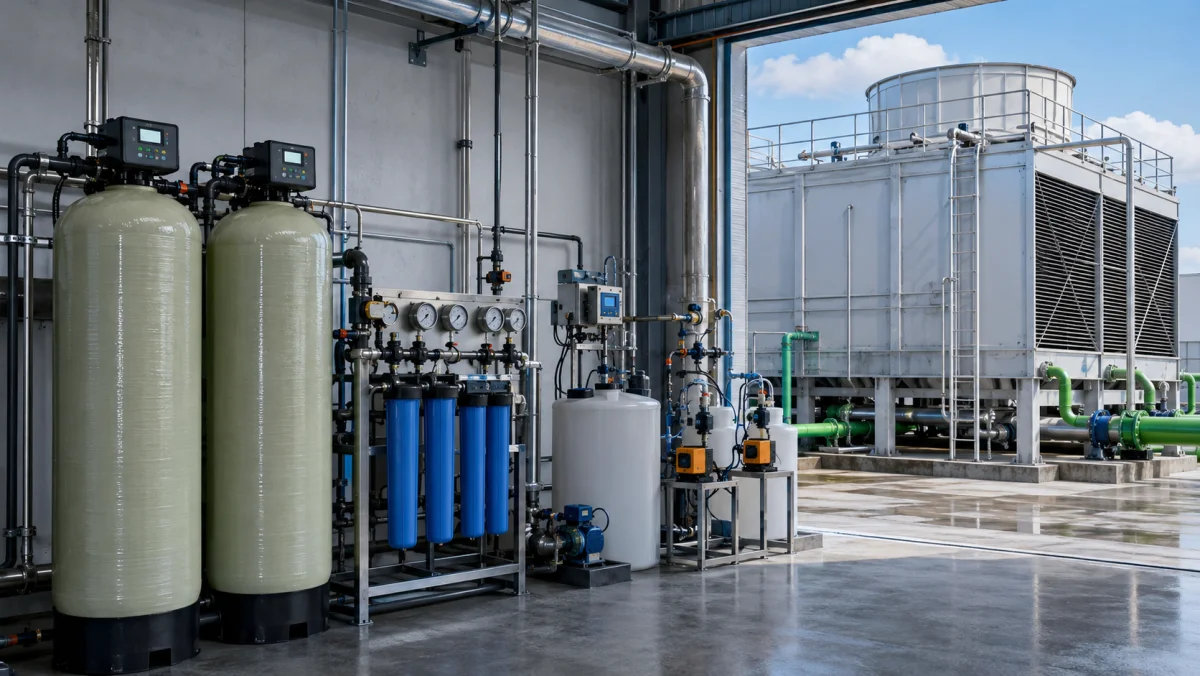
Typical treatment equipment
- mechanical filtration on makeup water;
- softening or reverse osmosis where required;
- chemical tanks and metering pumps;
- conductivity controller and blowdown valve;
- pH, temperature and flow sensors;
- side-stream filtration;
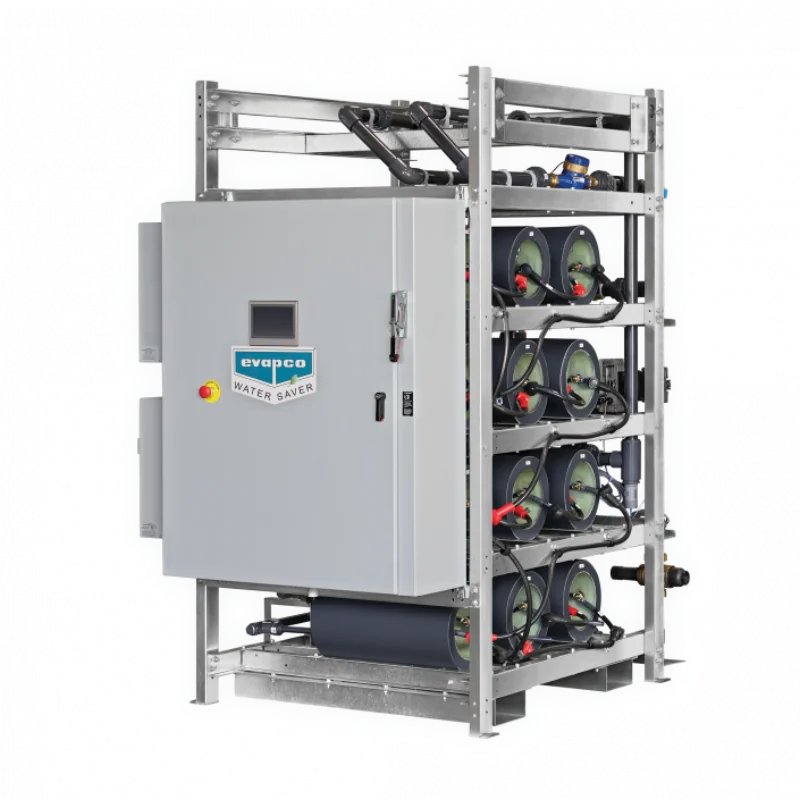
- sample points and a control panel.
Automation and laboratory monitoring
Chemicals may be dosed in proportion to makeup flow, by timer or from sensor signals. Controls should stop dosing when there is no flow and alarm for low chemical level, pump failure, high conductivity and sensor faults.
Automation does not eliminate water testing. Hardness, alkalinity, pH, conductivity, iron, chlorides, chemical residuals and microbiological indicators should be checked. Results are recorded and used to adjust the program before deposits or corrosion become visible.
Maintenance requirements
Routine service includes checking metering pumps, chemical levels, filters, blowdown valves, sensors and water quality. The basin, nozzles, fill and heat-transfer surfaces also require periodic inspection and cleaning.
After a long shutdown, the circuit should be flushed and microbiological condition checked before normal operation resumes. Shutdown and restart procedures should be included in the operating manual.
Conclusion
Cooling tower water treatment must control scale, corrosion, biological growth and dissolved-solid concentration at the same time. A reliable program combines makeup preparation, filtration, chemical dosing, automatic blowdown and laboratory monitoring. NIKLAND engineers select equipment and treatment programs according to water analysis, system materials, heat load and operating conditions.