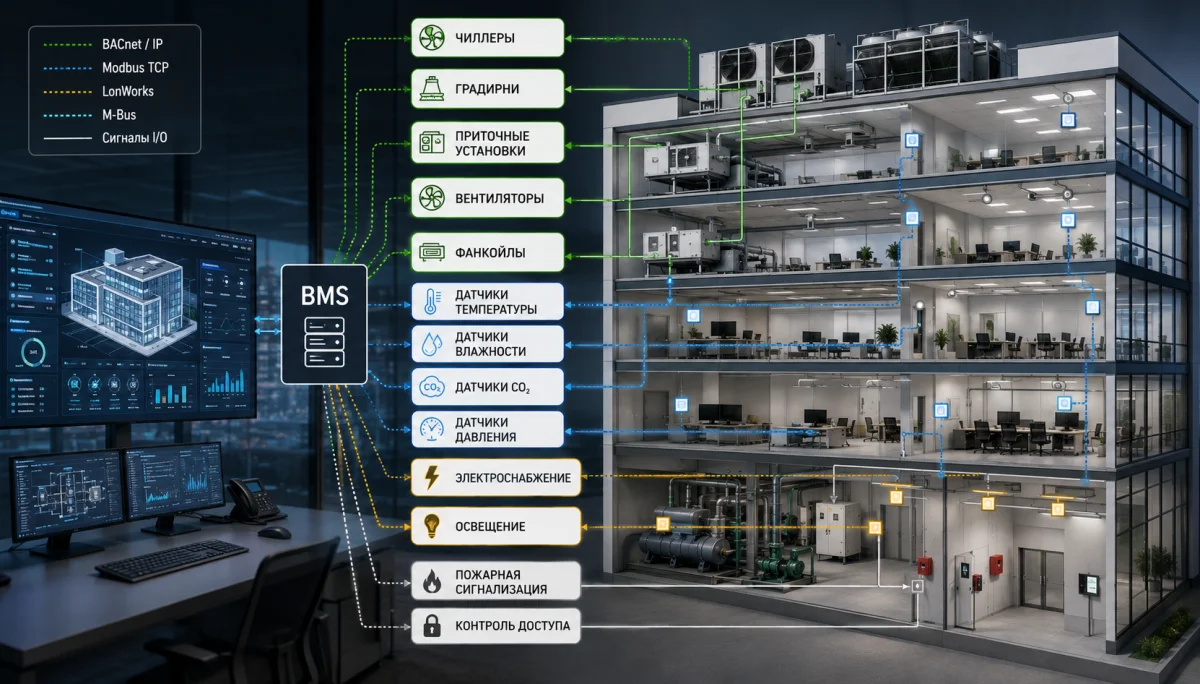
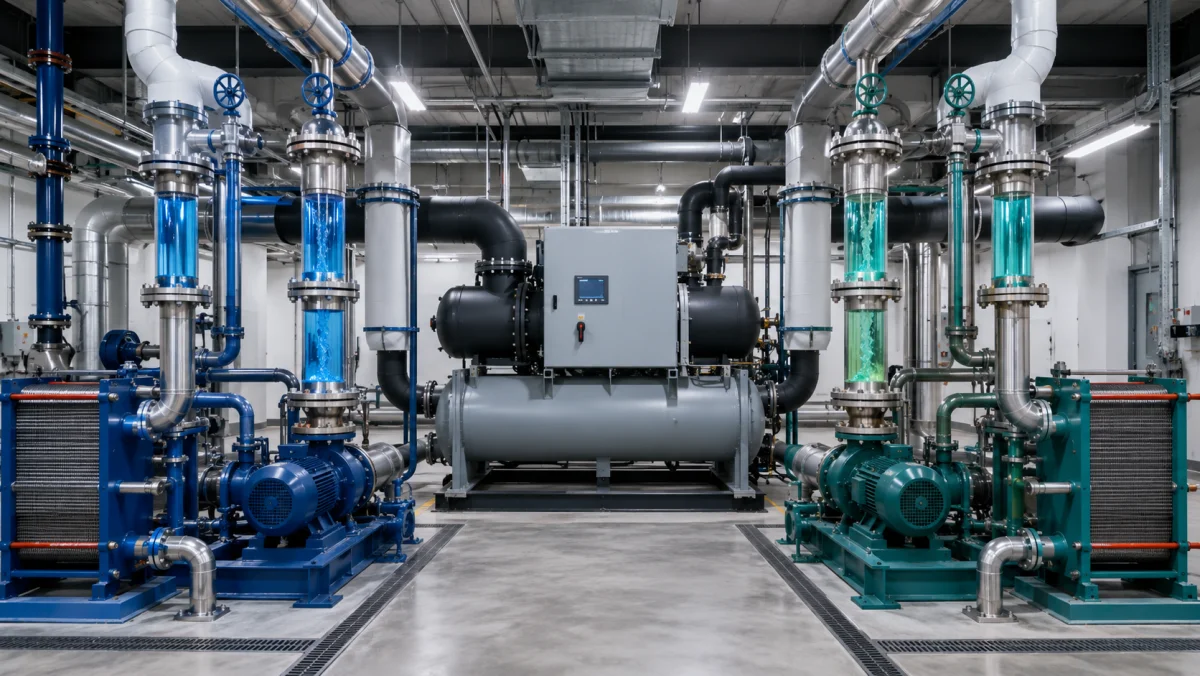
Glycol for a cooling system is used where water may freeze or equipment operates below 0 °C. Fluid selection affects cooling capacity, flow, pump head, energy use and maintenance.
Water has higher heat capacity and lower viscosity. Glycol protects against freezing but reduces heat transfer and increases resistance. Concentration should match the minimum temperature rather than include an excessive margin.
When water can be used
Water is suitable for circuits inside heated buildings where pipes, evaporators and pumps cannot freeze. It provides high heat capacity, good heat transfer and lower pumping energy.
Water quality still requires control. Hardness, salts, oxygen and suspended solids can cause corrosion, scale, blocked strainers and reduced performance.
When glycol is required
A glycol-based heat-transfer fluid for a chiller is needed for outdoor, rooftop or unheated circuits and winter shutdown risk. It is also used with dry coolers, free cooling and processes below 0 °C. Glycol does not replace insulation or controls, but it reduces freeze damage.
Water or antifreeze
The choice of water or antifreeze depends on minimum temperature and shutdown risk. Water is more efficient in protected circuits; antifreeze is required where freezing is possible. Automotive coolant should not be used: HVAC systems require dedicated inhibited fluids compatible with equipment.
Ethylene glycol for cooling
Ethylene glycol for cooling is common in closed industrial and commercial systems. It is usually less expensive and performs better thermally than propylene glycol. Its limitation is toxicity, so the circuit requires labeling, controlled handling and correct disposal.
Propylene glycol for chillers
Propylene glycol for a chiller is selected for food, healthcare and public buildings where lower toxicity matters. It is more viscous, particularly at low temperature, and therefore increases pressure loss and pump duty. Calculations should use manufacturer data.
Glycol concentration
Glycol concentration follows the required protection temperature. Too little gives insufficient freeze protection, while too much reduces heat capacity, thermal conductivity and pumpability. The design should distinguish first crystallization from full freezing and use a reasonable temperature margin.
Effect on cooling capacity
Glycol carries less heat than water. Maintaining capacity may require greater flow, a larger heat exchanger or another temperature difference. Manufacturers provide correction factors. Adding glycol after water-based selection can reduce actual chiller, fan-coil and dry-cooler capacity.
Effect on pumps and piping
Higher viscosity increases pressure loss through pipes, valves, strainers and heat exchangers. Pumps must be selected for actual concentration and temperature. Larger pipes or higher head may be needed, but excessive pump margin increases energy use and noise.
Corrosion and fluid quality
HVAC systems require inhibited glycol. Raw glycol does not adequately protect metals and seals. Over time, concentration, pH, clarity, sediment and inhibitor condition should be checked.
Maintaining a glycol circuit
Maintenance includes concentration, pH, color, sediment, strainers and leaks. Replacing every loss with water gradually reduces protection. Dark or unstable fluid may require analysis, correction or replacement, and used glycol must be disposed of as a technical fluid.
Protection temperature and operating temperature
Selection must consider not only minimum outdoor temperature but also the actual fluid temperature in the evaporator, dry cooler and exposed piping. In some operating modes, the fluid may become colder than the surrounding air, especially during pump shutdown or free-cooling operation.
For normal operation, concentration should keep the mixture sufficiently fluid and avoid excessive pressure loss. Burst protection alone does not mean that pumps and heat exchangers can operate correctly while ice crystals are forming.
Converting an existing water circuit to glycol
An existing water system can be converted only after engineering checks. Cooling capacity, flow, pressure loss, pumps, expansion vessel and minimum system volume must be recalculated. Compatibility with the evaporator, valves, gaskets, fan coils and other components should also be confirmed.
The old water and deposits are removed, the circuit is flushed and a premixed fluid is introduced. After startup, technicians measure flow, temperature difference and pressure to confirm that the system still provides the required capacity.
Water quality used for dilution
When concentrate is diluted on site, the water quality matters. Excess hardness, chlorides and suspended solids can weaken corrosion protection and create deposits. The fluid supplier should specify acceptable dilution-water properties.
Using demineralized or properly treated water can improve stability, but it must still be compatible with the inhibitor package. The final concentration should be checked after complete mixing and again after the system has circulated.
Common mistakes
- using automotive antifreeze;
- selecting concentration without minimum-temperature calculation;
- adding glycol without recalculating capacity and hydraulics;
- mixing incompatible products or inhibitor packages;
- using untreated fill water;
- not monitoring pH and concentration;
- replacing every fluid loss only with water;
- ignoring chiller-manufacturer requirements.
How to select the heat-transfer fluid
Prepared water is preferred where freezing is impossible. Glycol is used for outdoor or unheated sections. Ethylene glycol suits controlled industrial circuits, while propylene glycol is preferred where lower toxicity is required.
Final selection considers minimum temperature, capacity, flow, pump pressure, materials, toxicity and lifecycle cost. Fluid type and concentration should be stated in the design documentation.
Conclusion
Glycol for a cooling system is used for freeze protection, not to improve efficiency. Water provides better thermal performance but is safe only where positive temperature is guaranteed. Correct selection includes glycol type, concentration, hydraulics, equipment capacity and material compatibility. NIKLAND engineers calculate water and glycol circuits for chillers and industrial cooling systems.