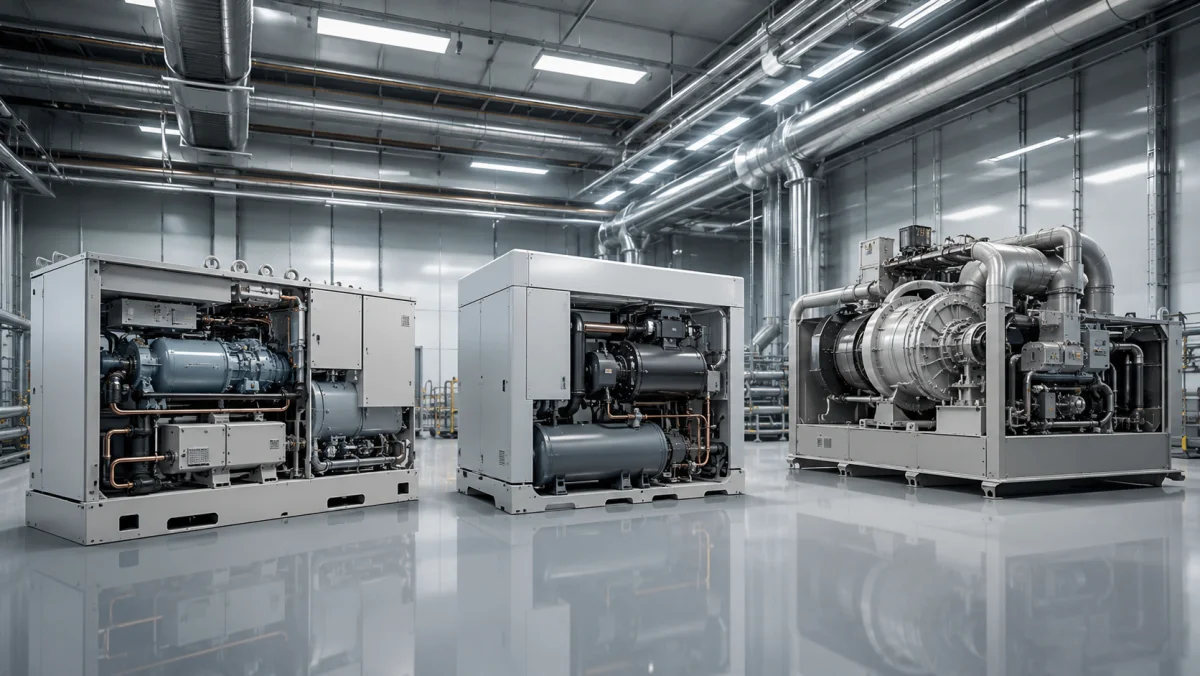
The compressor type determines capacity range, energy efficiency, sound, maintenance cost and chiller behavior at partial load. Equipment should therefore be compared not only by nominal cooling output but also by the types of chiller compressors used in each model.
Commercial and industrial systems most commonly use scroll, screw and centrifugal compressors. Each technology is designed for a different load range. There is no universally best option: the compressor for a chiller should be selected according to project capacity, annual cooling profile, water temperatures, redundancy requirements and operating cost.
Scroll chiller
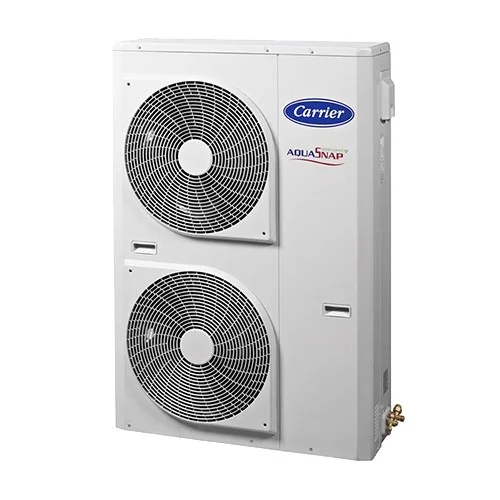
A scroll chiller uses one or more hermetic scroll compressors. Two spiral elements are located inside: one remains stationary while the other moves in an orbital path. Refrigerant pockets form between them, gradually become smaller and compress the gas.
The design contains relatively few moving parts and offers compact dimensions, moderate sound and good reliability. Scroll compressors are widely used in small and medium air-cooled and water-cooled chillers.
Advantages of the scroll design
- simple and compact construction;
- moderate sound and vibration;
- relatively affordable equipment cost;
- good efficiency within its intended range;
- staged control with several compressors;
- partial capacity remains after one module fails.
If a unit contains several compressors, the controller starts them in stages. This provides modularity and allows the chiller to continue operating after one compressor fails. Inverter scroll compressors may be used where smoother capacity control is required.
Limitations
A hermetic scroll compressor is normally replaced rather than rebuilt after a serious failure. At high total capacity, the number of compressors, refrigeration circuits, cables and control components increases. The arrangement may then become more complex and expensive than one or two screw compressors.
Screw chiller
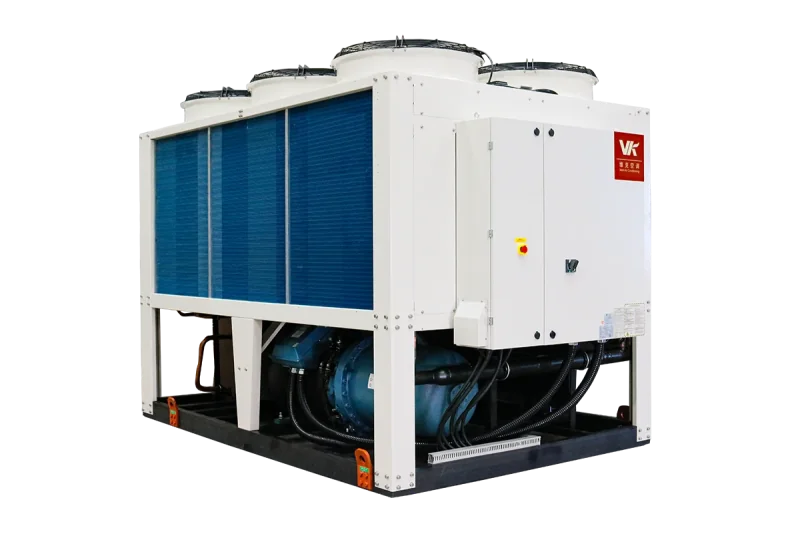
A screw chiller uses a rotary compressor with two profiled rotors. As the rotors turn, the volume between the rotor profiles and casing decreases and compresses the refrigerant. The construction is suitable for continuous duty and higher single-compressor capacity.
Screw compressors are used in medium and large air-cooled and water-cooled chillers. Typical applications include business centers, hotels, industrial plants, shopping complexes and other facilities with long cooling seasons.
Advantages of the screw design
- high cooling capacity per compressor;
- wide capacity-control range;
- stable operation during long operating cycles;
- serviceable individual components;
- fewer compressors at high total capacity;
- good suitability for industrial duty.
Capacity may be controlled with a slide valve, variable-frequency drive or both. A correctly selected screw compressor can operate effectively over a wide load range, but actual performance must be checked using manufacturer data.
Limitations
A screw machine is more complex than a scroll compressor and places higher demands on oil management and service personnel. Efficiency can fall at very low load, especially when the chiller has been selected with excessive spare capacity.
One large compressor also represents a larger share of total capacity when it fails. Critical facilities therefore use two refrigeration circuits, several compressors or several chillers.
Centrifugal chiller
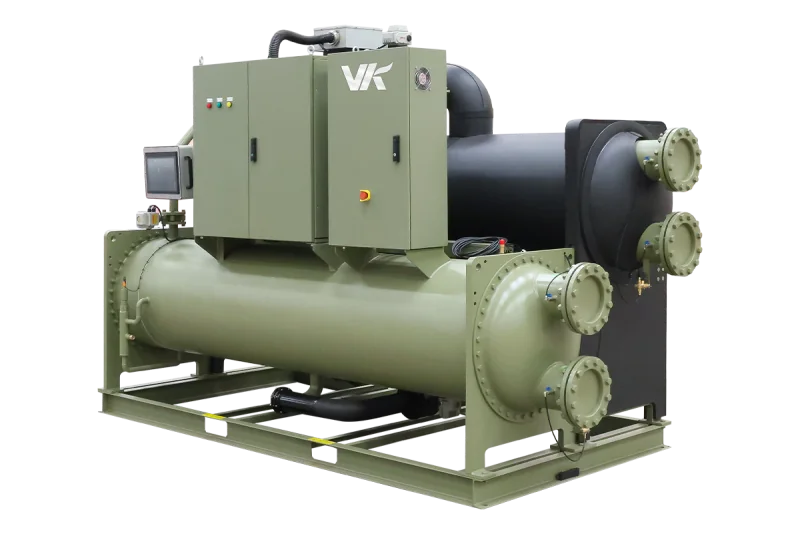
A centrifugal chiller uses a dynamic compressor. An impeller accelerates refrigerant flow, while a diffuser converts velocity into pressure. Compression is created by high rotational speed rather than by reducing a closed volume.
Centrifugal chillers are most commonly water cooled and applied on large projects such as airports, major shopping centers, industrial plants, data centers and district cooling systems.
Advantages of the centrifugal design
- very high capacity per machine;
- high efficiency at design conditions;
- strong seasonal performance when correctly selected;
- relatively low vibration;
- compact size in relation to capacity;
- availability of oil-free bearing designs.
Modern oil-free centrifugal compressors with variable-speed drives can be particularly efficient at suitable condensing temperatures and partial load. Removing oil from the refrigerant circuit helps maintain clean heat-transfer surfaces.
Limitations
Centrifugal technology requires accurate system design. The compressor must operate within a defined performance map, otherwise surge may occur. Controls must account for water temperature, cooling-tower performance and actual load.
Initial cost and requirements for plant-room infrastructure, water treatment and qualified service are usually higher. Heat rejection also requires a cooling tower, pumps, piping and condenser-water treatment, so the complete system must be compared.
Industrial chiller comparison by capacity
Scroll units are practical at small and medium capacity where modularity, simplicity and moderate cost are important. Screw machines suit medium and large duties and long industrial operation. Centrifugal chillers show their strongest advantage at high loads where efficiency can justify more complex infrastructure.
The exact capacity boundaries depend on the manufacturer. Modern scroll modules can be combined into large systems, while centrifugal compressors are also available in compact packages. Selection should not be based on a simplified capacity table alone.
Partial-load operation
A chiller operates below 100% load for much of the year. An industrial chiller comparison should therefore include seasonal efficiency, control method and minimum stable output instead of relying only on nominal EER or COP.
A scroll unit stages individual compressors, a screw compressor uses a slide valve or variable-speed drive, and a centrifugal machine controls rotational speed and inlet guide vanes. The best result is achieved when the modulation range matches the actual building load profile.
Reliability and redundancy
Several scroll compressors provide built-in modularity. A screw machine contains fewer compressors, but each one carries a larger share of the load. A centrifugal chiller is often a major single cooling source, so critical projects use several machines.
Reliability assessment should include the number of refrigeration circuits, spare-parts availability, local service capability and component replacement time. Two smaller chillers may sometimes provide more resilient operation than one large high-efficiency unit.
Maintenance
A seriously damaged hermetic scroll compressor is normally replaced. A screw compressor requires oil, filter, bearing and separator checks. A centrifugal machine requires diagnostics of bearings, impeller, drive and controls.
Regional service support may be more important than a small efficiency difference. Before purchase, the owner should verify delivery times for compressors, control boards, sensors, oil and special service tools.
How to choose a compressor for a chiller
- small and medium facilities often suit a scroll chiller;
- continuous medium and large duties often suit a screw chiller;
- large central cooling plants often suit a centrifugal chiller;
- critical loads require several circuits or machines;
- variable loads require a wide modulation range.
Selection begins with design and minimum loads, water temperatures, operating schedule and condenser type. The engineer then compares annual energy use, redundancy, sound, installation area and maintenance cost.
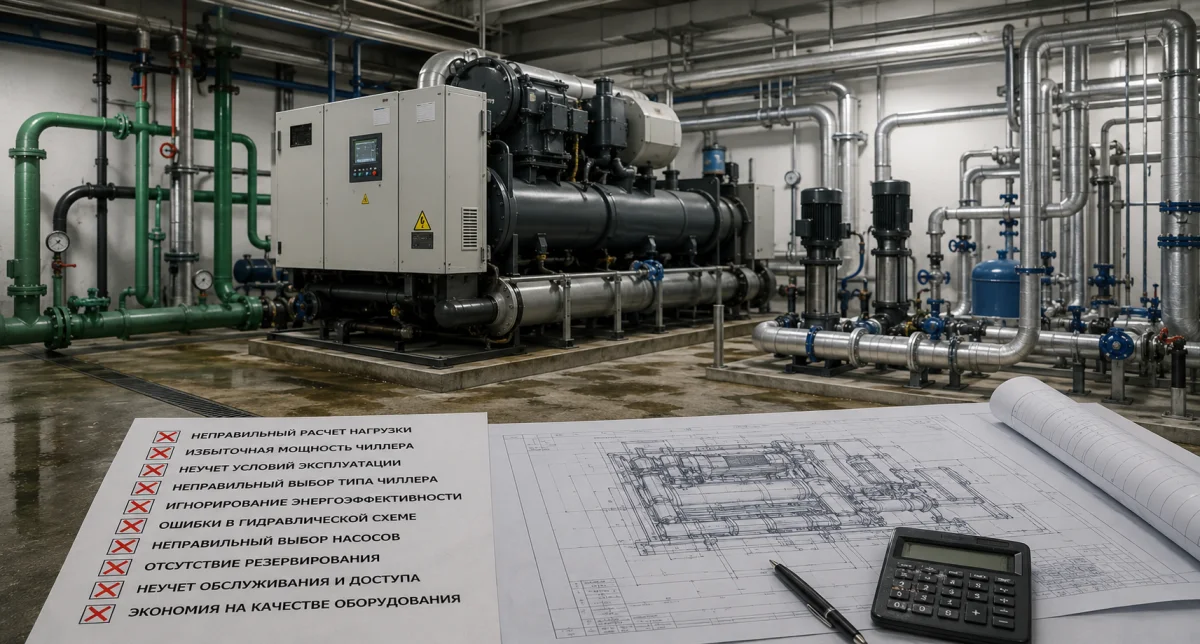
Common mistakes
- comparing nominal capacity only;
- ignoring partial-load operation;
- selecting excessive spare capacity;
- omitting redundancy calculations;
- evaluating the chiller without pumps and tower;
- choosing equipment without available service support.
Conclusion
The main types of chiller compressors solve different engineering tasks. Scroll technology offers modularity and simplicity, screw technology provides high capacity and suitability for continuous duty, while centrifugal technology delivers strong efficiency on large installations. The correct choice is determined by design load, seasonal profile, redundancy and total operating cost. NIKLAND engineers compare the available options using actual project conditions and select the chiller as part of the complete cooling system.