Humidification in ventilation systems is required where cold outdoor air becomes excessively dry after winter heating and where occupants, materials or production processes need stable indoor conditions. The opposite process, air dehumidification, is necessary in summer, swimming pools, food facilities, archives, healthcare rooms and buildings with high moisture generation.
Temperature control alone does not guarantee comfort or safety. Low humidity can dry mucous membranes, increase airborne dust and static electricity, and deform timber or paper products. High humidity can cause condensation, corrosion, mold growth and damage to finishes. For this reason, humidity control should be included in ventilation and air-conditioning design.
What determines indoor humidity
Indoor humidity is affected by outdoor weather, outdoor-air volume, air temperature after heating or cooling, occupancy, open water surfaces, wet processes, cooking, cleaning and exhaust-air operation.
Controls normally measure relative humidity. Heating air lowers relative humidity even when no moisture is removed, so cold winter air can become very dry after a heating coil. Cooling air below its dew point condenses water vapor on a coil and provides dehumidification.
Steam humidifier
A steam humidifier introduces ready-made water vapor into the air stream. Steam may be generated by electrodes, electric heating elements or an external steam source. This method provides accurate modulation and causes almost no reduction in supply-air temperature.
Steam systems are suitable for hospitals, laboratories, clean rooms and other facilities where hygiene and precision are important. A sufficient absorption distance must be provided downstream of the distributor so that vapor mixes completely and does not condense on duct walls, filters or coils.
Disadvantages include electrical energy use, water-quality requirements and regular cleaning of cylinders or heaters. Drains, steam piping and consumable components also require inspection and maintenance.
Adiabatic humidification
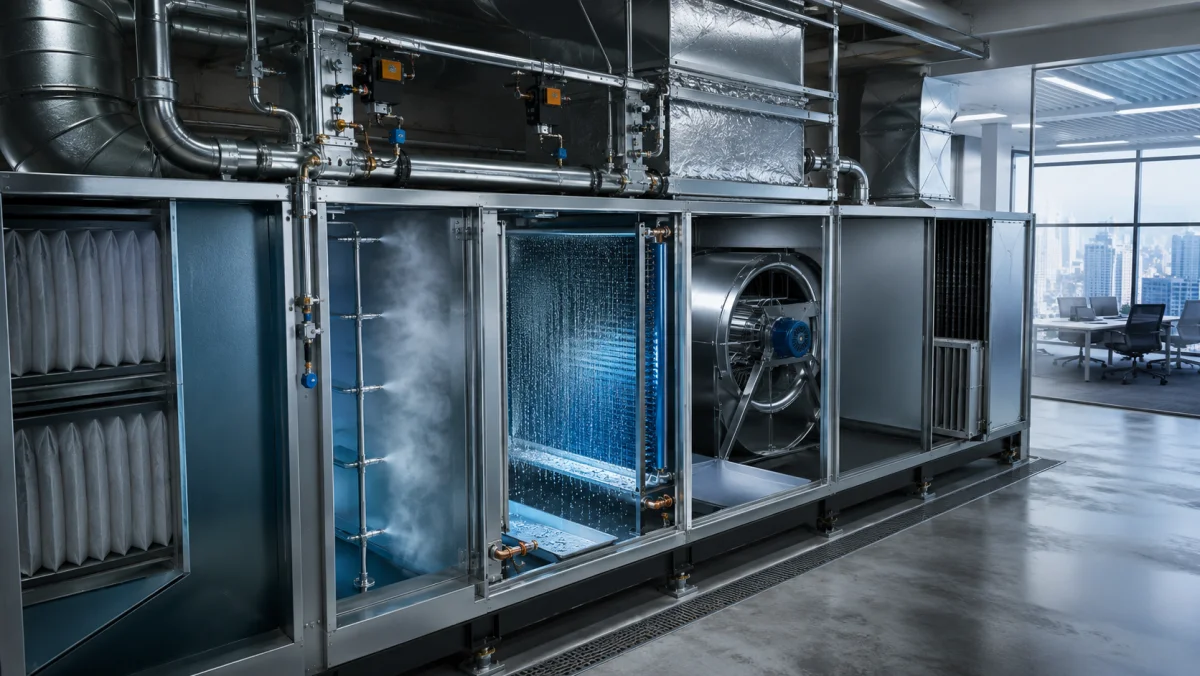
Adiabatic humidification evaporates fine water droplets without direct water heating. Water is atomized by high-pressure nozzles or supplied to an evaporative medium. Evaporation takes heat from the air, so moisture content rises while air temperature falls.
This method consumes less electricity than an electric steam humidifier and can reduce summer cooling demand. During winter, additional heating is often required after the humidification section. Safe operation requires treated water, correct air velocity, an evaporation chamber and a droplet eliminator.
Water that does not evaporate must drain without stagnation. Pans and internal surfaces require regular flushing and disinfection because permanently wet areas can support biological growth.
Dehumidification by cooling
The most common form of air dehumidification cools air below its dew point. Moist air passes over a cold coil, water vapor condenses and condensate is removed through a drain pan. The dry air often requires reheating to reach the required supply temperature.
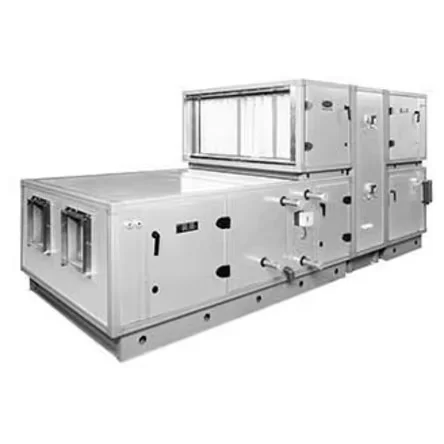
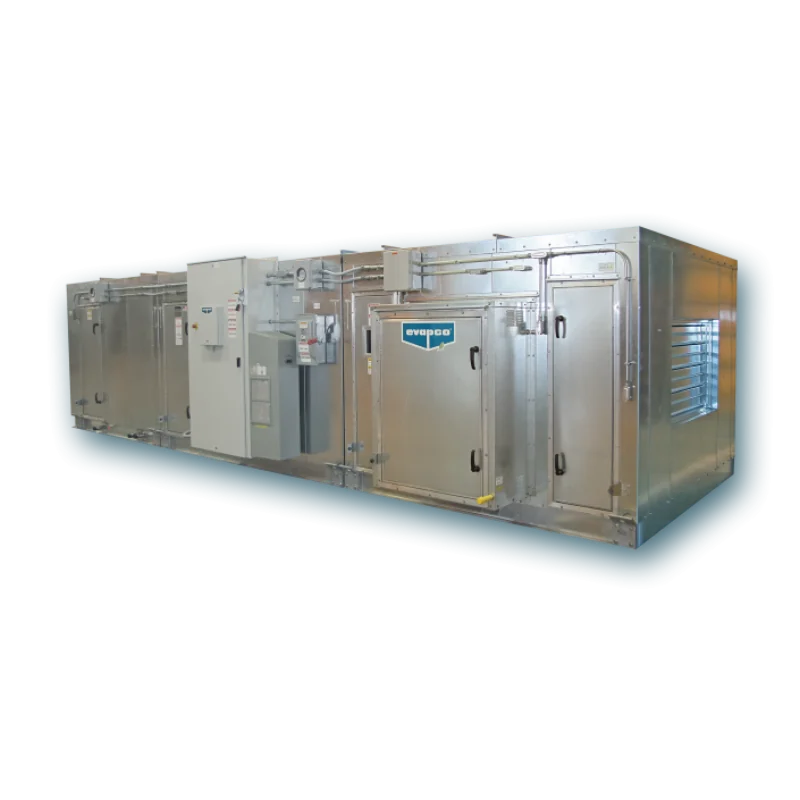
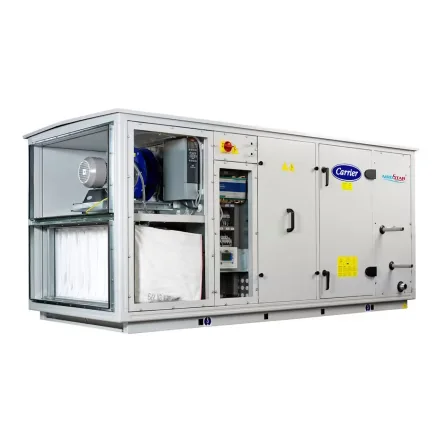
This process is used in central air-handling units, ducted systems, cooling coils and packaged dehumidifiers. Moisture-removal capacity depends on coil surface temperature, airflow, entering moisture content and chilled-water temperature.
Cooling capacity cannot be evaluated only by temperature reduction. A unit may cool the air but remove insufficient moisture if water temperature is too high, the coil has too few rows or air velocity is excessive.
Desiccant dehumidification
When very low humidity is required or the air temperature is low, a desiccant dehumidifier may be used. A wheel containing a moisture-absorbing material removes water from process air, while a separate heated stream regenerates the material.
These systems are used in pharmaceutical facilities, cold stores, electronics production and archives. They operate where condensation dehumidification becomes inefficient, although they require regeneration energy and more advanced controls.
Capacity calculation
Humidifier output is calculated from the difference in humidity ratio before and after treatment and the dry-air mass flow. The calculation includes outdoor and recirculated air, internal moisture generation, leakage, startup conditions and the required time to reach the setpoint.
For dehumidification, designers prepare a moisture balance covering outdoor air, occupants, processes, evaporation, infiltration and the required exhaust-air condition. Peak temperature does not always coincide with maximum outdoor moisture content, so several climatic design points should be checked.
Humidity control and automation
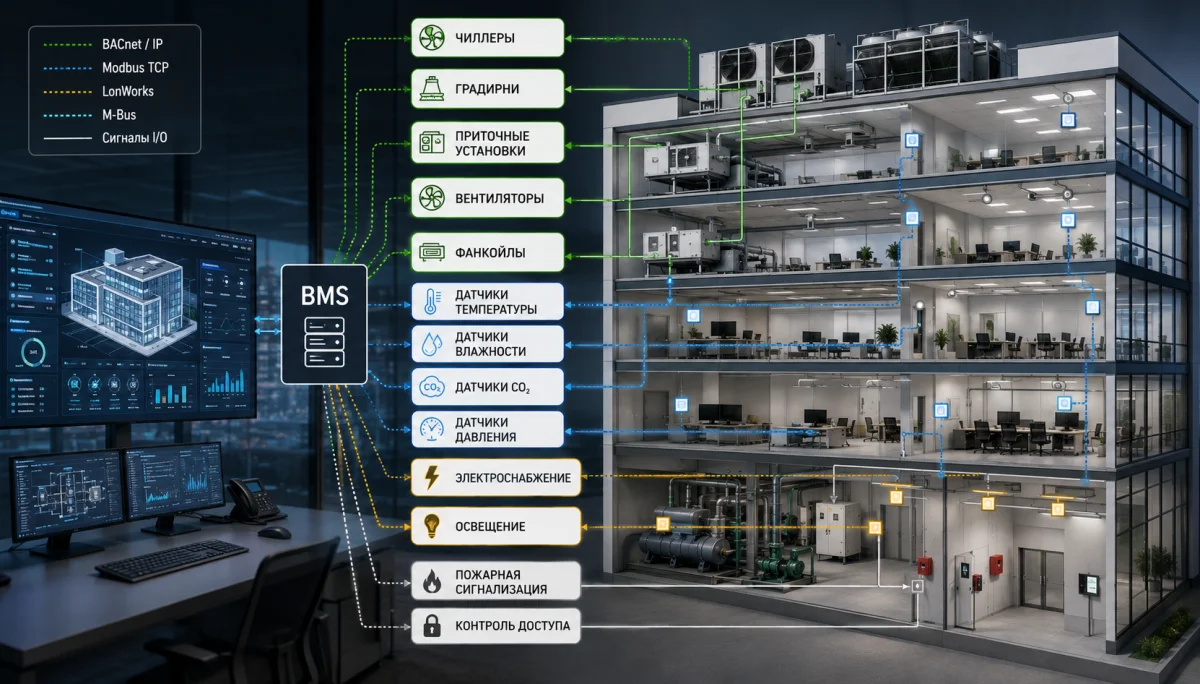
Humidity control uses sensors in rooms, supply air and return or exhaust air. A high-limit sensor downstream of the humidifier protects the duct from over-humidification. Controls must stop water or steam when the fan is off, airflow is insufficient or a drainage alarm occurs.
Humidification, dehumidification, heating and cooling must be coordinated. Otherwise, the system may humidify and dehumidify at the same time and waste energy. Sensors should be located away from doors, windows, diffusers and local steam sources, and their readings require periodic verification and calibration.
Water treatment and hygiene
Water quality affects equipment life, scale formation and hygiene. Electrode humidifiers require suitable conductivity. High-pressure systems commonly use softening, reverse osmosis or demineralization to reduce deposits and mineral carryover.
Drain pans should slope toward the outlet and internal surfaces must be accessible for inspection and cleaning. Standing water, contamination from drains and droplet carryover must be prevented. Healthcare and food facilities normally require especially strict sanitation procedures.
Energy efficiency
Energy use depends on humidifier type, air temperature before treatment, heat-recovery efficiency, reheat after dehumidification, pump pressure and filter resistance. Heat recovery, weather-based control and accurate operating schedules can reduce consumption.
Common mistakes
- selecting equipment without a moisture-balance calculation;
- installing a sensor in an unrepresentative location;
- omitting a high-limit sensor after the humidifier;
- providing insufficient steam absorption distance;
- using untreated water and allowing rapid scale formation;
- leaving standing water in pans or drains;
- dehumidifying without accounting for reheat;
- simultaneous humidification and dehumidification;
- ignoring the building-envelope dew point;
- providing no access for cleaning and maintenance.
Conclusion
Humidification in ventilation systems and dehumidification should be calculated together with temperature, airflow and room use. Steam humidifiers provide high accuracy, while adiabatic humidification can reduce electrical consumption at high capacity. Moisture is removed by cooling below the dew point or by desiccant technology. NIKLAND engineers select central air conditioners, hygienic air-handling units, humidification and dehumidification sections, water-treatment equipment and controls for Kazakhstan's climate and each facility's requirements.