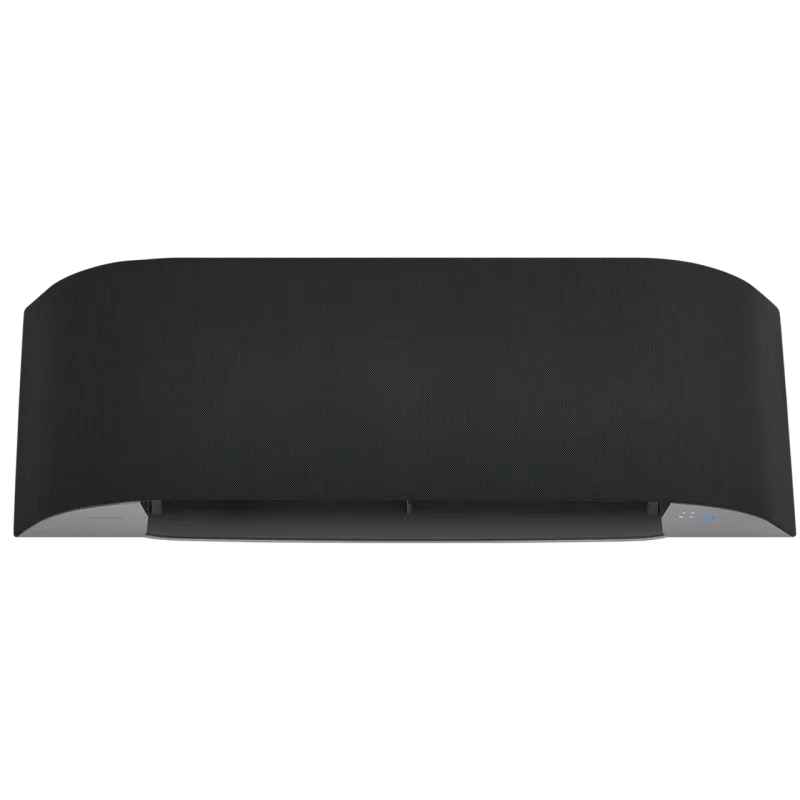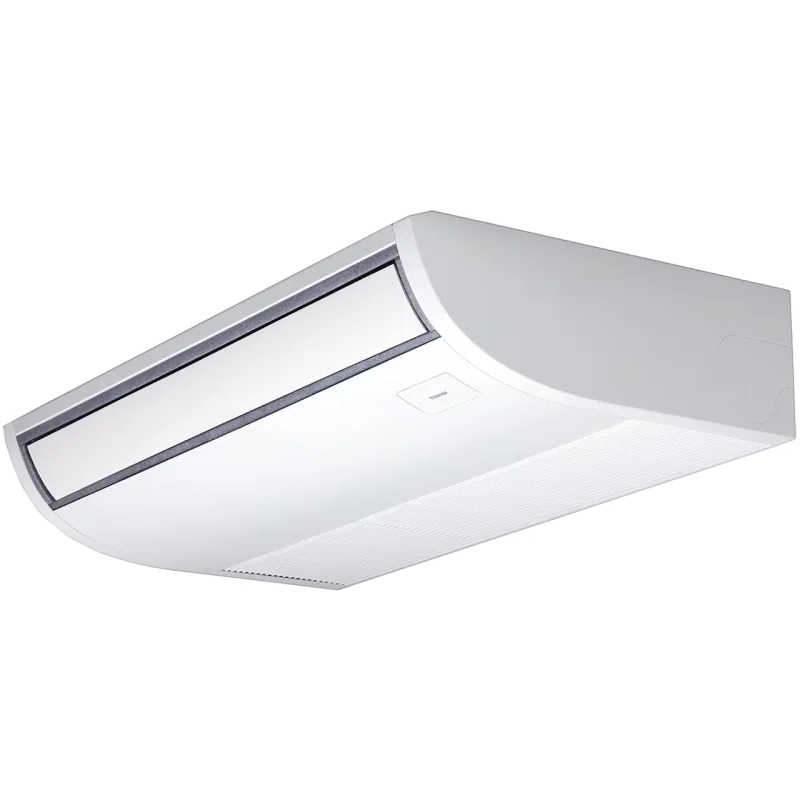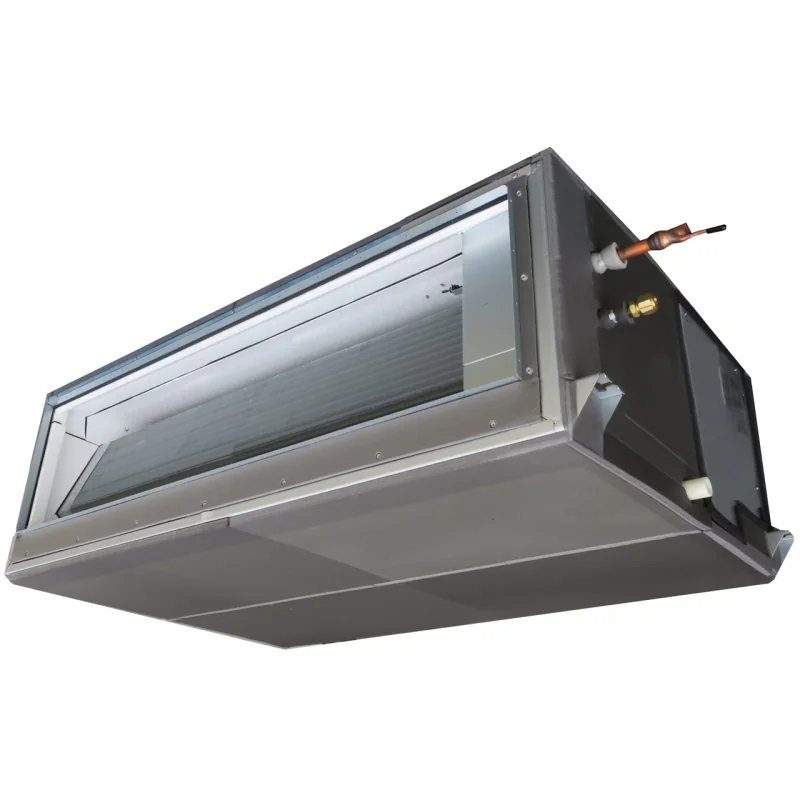
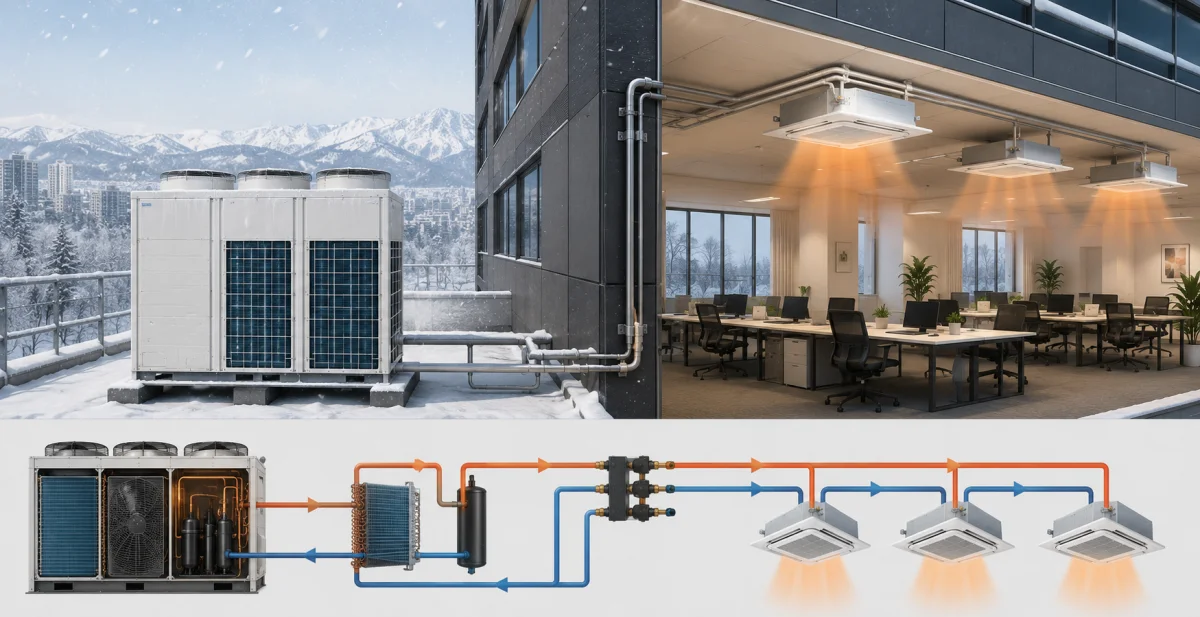
A VRF system in winter can provide both cooling and heating through a reversible refrigeration cycle. The outdoor unit extracts heat from ambient air, raises its temperature level with the compressor and transfers that energy to indoor units. For commercial facilities, one system can combine air conditioning and space heating.
Winter VRF operation in Kazakhstan requires more careful design than operation in a mild climate. As outdoor temperature falls, available heating capacity decreases, compressor demand rises, frost develops on the outdoor coil and the system periodically enters defrost mode. Equipment must therefore not be selected from nominal catalogue capacity alone.
How VRF heating works
VRF heating in winter operates as an air-source heat pump. In heating mode, the outdoor heat exchanger becomes the evaporator and absorbs heat from the air. Refrigerant is compressed, becomes hotter and flows to the indoor units, where it condenses and releases heat into the rooms.
Inverter control changes compressor output according to current demand. When some rooms have reached their setpoints, the system reduces refrigerant flow to those areas and directs more capacity to zones that still need heat. This makes VRF office heating practical for buildings with many rooms and different occupancy schedules.
Can air conditioning operate below freezing?
A standard residential split system and a commercial VRF system are not equivalent in cold weather. An air conditioner below freezing should only operate within the range specified by the manufacturer for the exact model and operating mode. The permitted limits for winter cooling and winter heating are also different.
Modern VRF outdoor units may be designed for low ambient temperatures, but the stated minimum does not mean that full capacity is maintained throughout the range. Designers must review correction tables for heating output, efficiency and electrical input. If the city design temperature is below the approved range, the system cannot be treated as the sole heat source without another solution.
Kazakhstan climate conditions
Kazakhstan has widely different winter conditions. In Almaty, humid cold, frosting and rapid temperature changes are important. In Astana, Karaganda, Pavlodar and northern regions, design temperatures are much lower and wind increases exposure of outdoor units. Shymkent and southern cities generally have milder heating seasons, allowing VRF to cover a larger share of annual heat demand.
The design must use climate data for the actual city and the number of hours at each temperature. VRF may cover most of the heating season while backup heat operates during the coldest periods.
Heating-capacity reduction in cold weather
As outdoor temperature falls, less heat is available for the outdoor coil to absorb. At the same time, building heat loss rises. The gap between building demand and equipment capacity can therefore increase quickly.
An outdoor unit selected from nominal standard conditions may fail to provide the required output at winter design temperature. The building heat load must be calculated by zone and compared with actual manufacturer performance at the selected outdoor condition. A high indoor-unit connection ratio does not compensate for reduced winter capacity.
Outdoor-unit defrost operation
At low temperature and high humidity, frost forms on the outdoor heat exchanger. Frost restricts airflow and reduces heat transfer. The controller periodically starts a defrost cycle by temporarily changing refrigerant operation to warm the coil and remove ice.
During defrost, some indoor units may reduce or stop heat delivery for a short period. Occupants can notice a pause or a change in discharge-air temperature. Frequency and duration depend on weather, coil condition, outdoor-unit placement and manufacturer control logic. Rooms requiring uninterrupted heating need an appropriate backup source.
VRF heat pump as the main heat source
A VRF heat pump can serve as the main heating source when calculations confirm adequate output throughout the required temperature range and the building can tolerate defrost behavior. This approach is most suitable for well-insulated buildings with moderate heat loads and many independently controlled zones.
In northern Kazakhstan, VRF is often used as the primary source during shoulder seasons and as supplementary heating in severe winter weather. Hydronic heating, electric convectors, air curtains or another source can cover the coldest hours. A bivalent arrangement can reduce conventional heating capacity while improving overall reliability.
VRF office heating
VRF office heating is convenient because every indoor unit can be controlled separately. Staff can set temperatures for offices, meeting rooms and open-plan areas. Unoccupied zones can use an economical setting, while central control prevents conflicting setpoints.
Indoor units heat room air rather than the building structure. After a long shutdown, the air temperature may recover quickly while walls, furniture and floors remain cold. Stable comfort therefore requires suitable night setbacks and a scheduled start before occupancy.
Outdoor-unit placement
Outdoor units must not be placed where snow blocks the intake or defrost water freezes beneath the equipment. The base should be raised above the expected snow level, water drainage should be provided and service clearances must remain accessible. Wind protection may be used only when it does not restrict airflow.
A unit should not be installed in a confined recess or under a structure that causes recirculation of cold discharge air. Multiple modules must follow manufacturer spacing requirements. Poor placement reduces output, increases defrost frequency and can cause protective shutdowns.
Service before the heating season
Winter VRF operation begins with preventive maintenance. Before cold weather, technicians clean indoor and outdoor coils and check fans, drains, electrical connections, refrigerant condition and system pressures. A dirty outdoor coil frosts more quickly and transfers less heat.
Fault history, temperature sensors, crankcase heaters, outdoor-unit supports and pipe insulation should also be inspected. After service, the system should be tested in heating mode and indoor discharge temperature checked. Commercial buildings benefit from a maintenance agreement with emergency response.
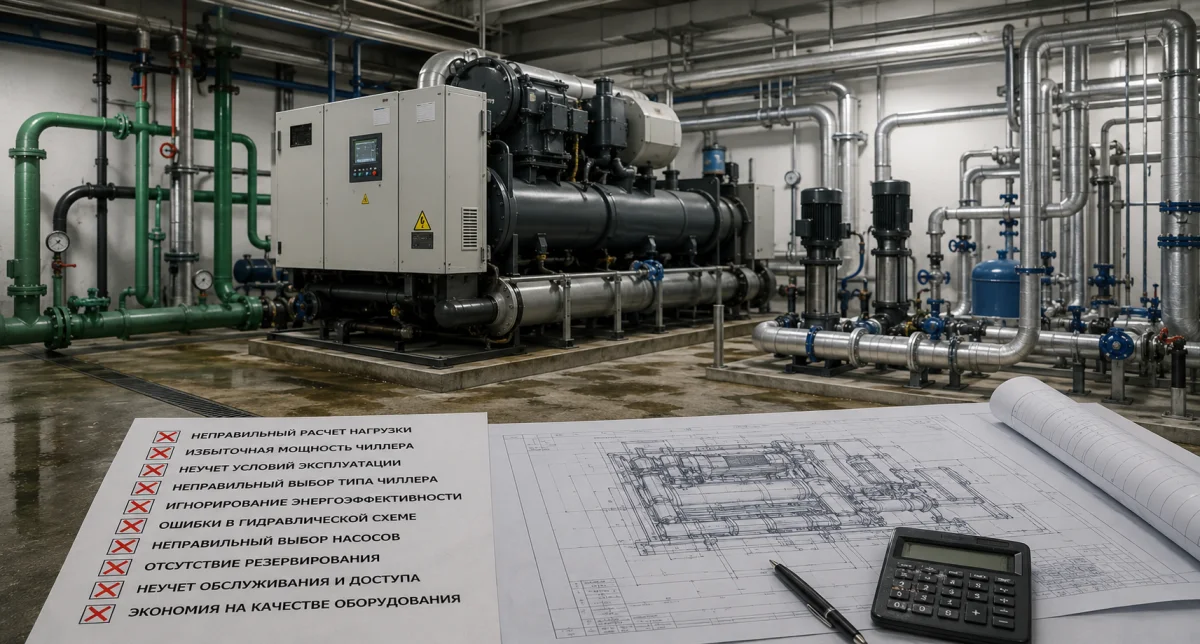
Common mistakes
- selecting the outdoor unit from nominal capacity only;
- ignoring low-temperature correction tables;
- using VRF as the only heat source without backup calculations;
- placing outdoor units in snow or recirculating airflow;
- failing to drain defrost water;
- disconnecting outdoor-unit power during winter;
- errors in pipe length, diameter or refrigerant charge;
- no centralized operating-mode control;
- delayed heat-exchanger cleaning.
Conclusion
A VRF system in winter can heat offices and other commercial buildings efficiently, but its capability depends on the exact model, local climate and quality of the design. Kazakhstan projects must verify low-ambient performance, account for defrost operation, provide correct outdoor-unit placement, maintain power to protective heaters and include backup capacity for severe frost. NIKLAND engineers calculate loads, select VRF equipment and controls, design refrigerant piping and define the winter heating strategy for each facility.