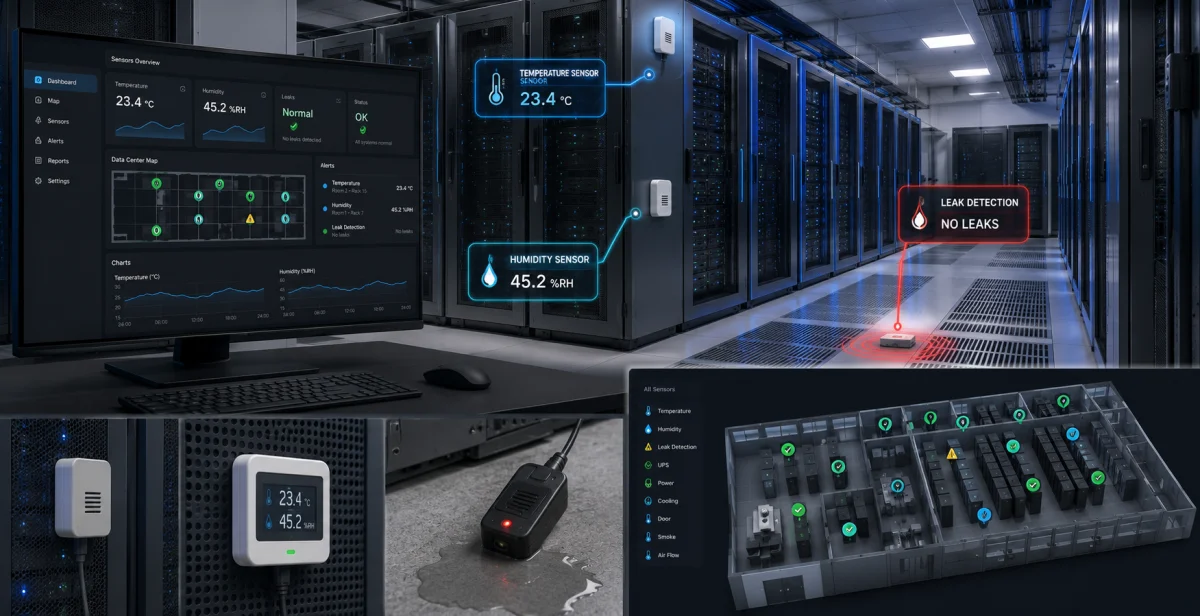
Data center environmental monitoring is required for much more than displaying the current room temperature. A complete system should monitor temperature and humidity at multiple points, cooling-system status, water beneath equipment, door position, sensor power and the rate at which conditions change. Early detection provides time to start standby cooling, repair a leak or reduce rack load.
A single wall-mounted sensor cannot represent actual conditions. Data centers develop local hot spots, recirculation of exhaust air, uneven cooling distribution and significant temperature differences between the top and bottom of a rack. Monitoring should therefore be designed as a network of sensors, controllers, gateways and software with event history and automatic notifications.
Which parameters should be monitored
The basic set includes air temperature, relative humidity and water leakage. Larger facilities also monitor pressure difference between cold and hot aisles, airflow, water and refrigerant temperatures, fan status, filter condition, pumps, valves and standby cooling units.
- air temperature at server-rack inlets;
- temperature in hot aisles and near the ceiling;
- relative humidity and dew point;
- water beneath raised floors and near piping;
- operation of precision units, chillers and pumps;
- fan, compressor and humidifier alarms;
- opening of doors, cabinets and technical rooms;
- sensor power, UPS supply and communication status.
Server room temperature sensors
Server room temperature sensors should be installed where they represent the air entering IT equipment, not simply where cabling is easiest. The main reference is the front of the racks, where cold air is drawn into servers. One measurement is insufficient for a tall rack because the upper servers can receive much warmer air than the lower equipment.
A practical arrangement measures the lower, middle and upper sections of representative racks. Additional sensors are installed in hot aisles, beneath the raised floor, near cooling-unit outlets and in likely recirculation zones. The number of points depends on room size, IT load density and airflow design.
Data center humidity control
Data center humidity control protects equipment from two opposite risks. Very dry air increases the possibility of electrostatic charge, while excessive moisture raises the risk of condensation and corrosion. Dew point should be evaluated together with relative humidity.
Relative humidity changes when air temperature changes. Rapid cooling can increase relative humidity even without additional moisture entering the room. Dew point indicates how close pipes, heat exchangers or equipment surfaces are to condensation conditions.
Humidity sensors should be installed in several representative zones, but not directly in humidifier discharge or beside an open door. They require periodic verification and calibration because gradual sensor drift can cause incorrect humidification or dehumidification control.
Water leak detection system
A water leak detection system should identify liquid before it reaches cables, server racks or electrical panels. Risk sources include chilled-water and glycol pipes, cooling-unit drains, humidifiers, heat exchangers, pump assemblies and adjacent rooms.
Point sensors are suitable for small local areas. For longer zones, sensing cable is installed along piping, beneath cooling units, around pump assemblies and around vulnerable sections below the raised floor. The controller should identify not only that a leak exists but, where possible, the affected cable section.
Sensing cable should not be placed where it remains wet from normal condensation or interferes with maintenance. During commissioning, every monitored section should be tested with actual water rather than only using the panel test button.
Server room cooling monitoring
Server room cooling monitoring must show the condition of the entire heat-removal chain. It is not enough to know that an indoor unit is running. Operators need supply and return air temperatures, compressor mode, fan speed, filter condition, valve position and active alarms.
Hydronic systems additionally require chilled-water supply and return temperatures, differential pressure, pump status, flow and the condition of the chiller or dry cooler. Where N+1 redundancy is provided, monitoring must confirm standby readiness and record automatic changeover.
It is useful to compare the temperature difference across cooling equipment with the current IT load. A falling temperature difference at the same load may indicate low airflow, a dirty heat exchanger, insufficient refrigerant or an incorrectly positioned valve.
DCIM monitoring and BMS integration
DCIM monitoring combines engineering-infrastructure data with IT-equipment information. One interface can display rack temperatures, electrical loading, cooling status, available capacity and alarm history. This helps relate increasing heat load to specific racks and evaluate the effect of installing new servers.
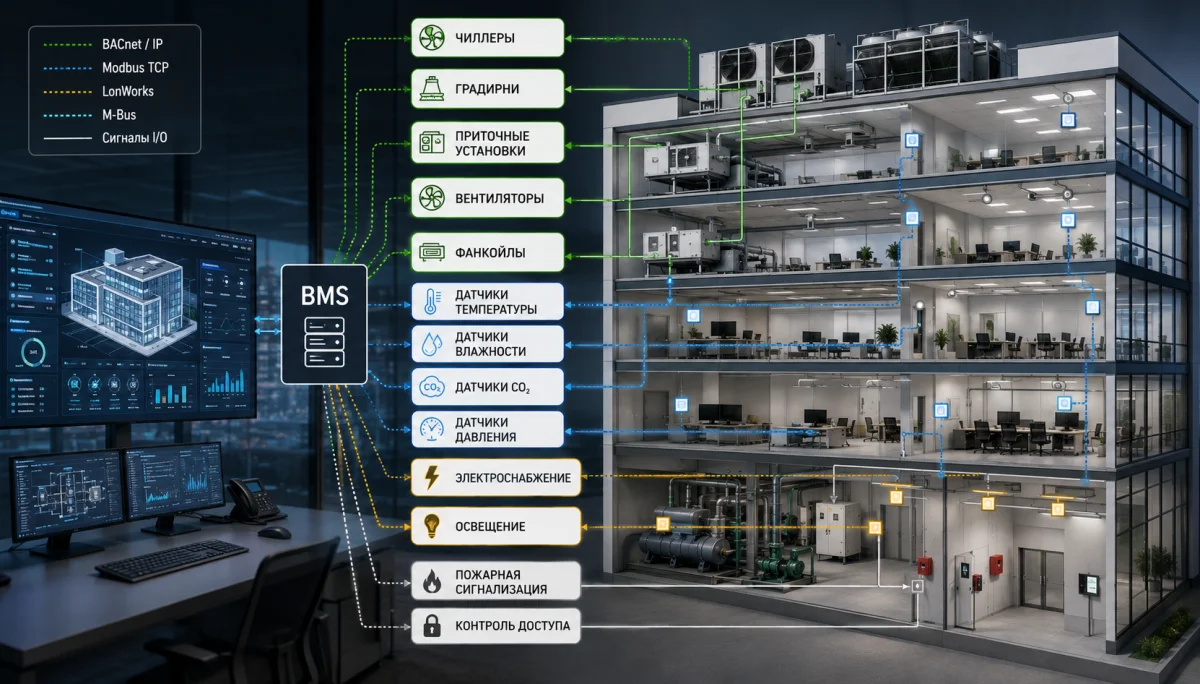
A BMS usually manages building engineering systems such as chillers, pumps, ventilation and valves. DCIM works more deeply with racks, power distribution and IT capacity. The platforms can exchange information through BACnet, Modbus, SNMP, APIs or digital contacts to avoid isolated interfaces.
Thresholds and alarm levels
Each parameter should have several levels, such as warning, critical alarm and emergency. One hard limit provides notice too late. A warning should allow time for investigation, while a critical level should initiate a predefined response procedure.
Thresholds depend on sensor location, server requirements and the facility's normal operating mode. Delay and hysteresis prevent short fluctuations from generating repeated notifications. The system should also alarm on a rapid temperature change, communication loss and sensor failure.
Installation and commissioning
Before installation, the designer should prepare a sensor-location plan and assign clear names to every point. After installation, technicians compare nearby readings, simulate heating, humidity and leakage events, and interrupt power and communications. Every alarm must appear in the event log and reach the correct recipient.
Handover documentation should include the point layout, network addresses, measuring ranges, thresholds, calibration instructions and response procedures. Without this information, later service becomes a search for unidentified sensors beneath floors and inside cabinets.
Common mistakes
- using one temperature sensor for the entire server room;
- measuring only near the cooling unit instead of rack inlets;
- no monitoring at the top of tall racks;
- leak detection only beneath one indoor unit;
- identical thresholds for every zone;
- repeated notifications without delay or hysteresis;
- no protected power for controllers;
- no alarm for lost sensor communication;
- messages without an exact location;
- humidity sensors that are never verified.
Conclusion
Data center environmental monitoring should identify local overheating, humidity deviation, water leaks and cooling failures before they affect servers. This requires correctly positioned sensors, supervision of the complete cooling chain, historical data, redundant communications and clear notification procedures. NIKLAND engineers design cooling systems for data centers and server rooms with redundancy, monitoring, temperature sensors, humidity control and leak detection.