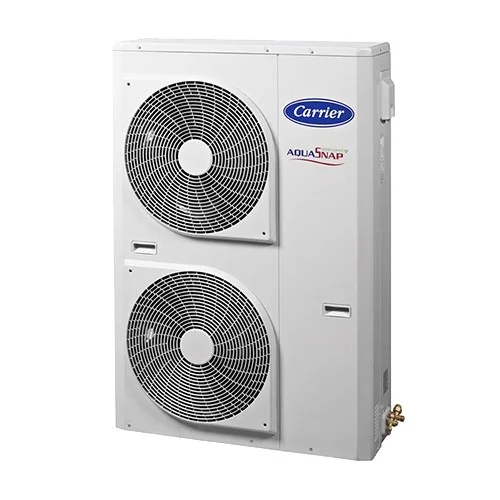
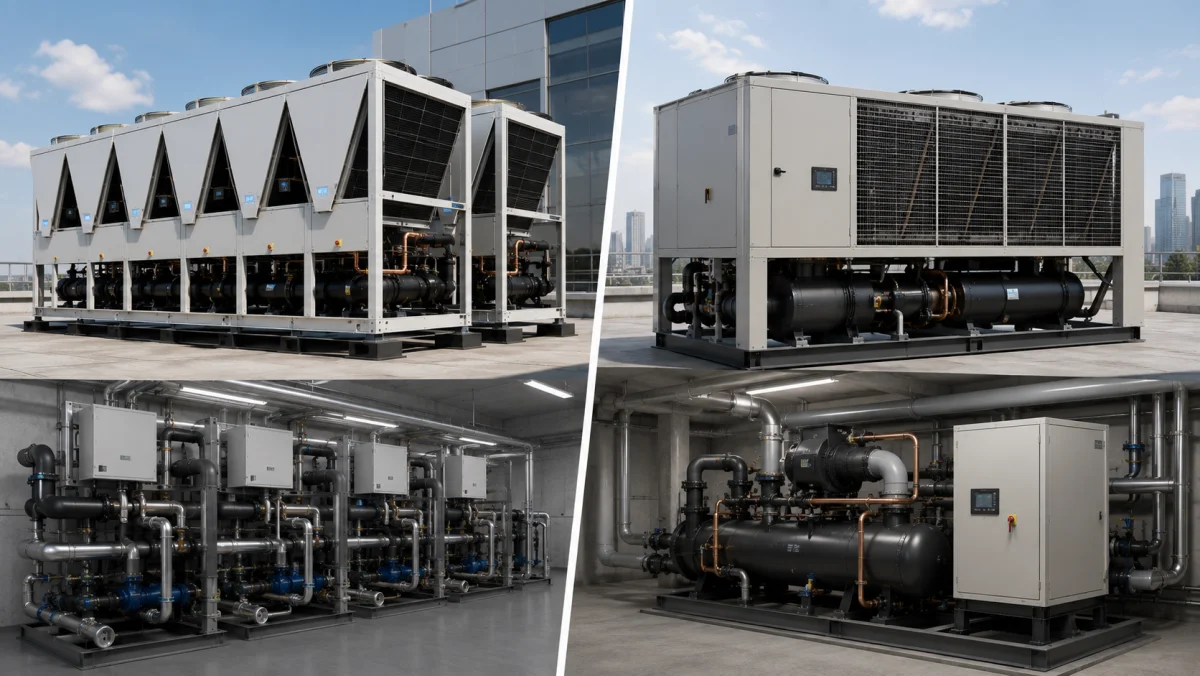
A modular chiller is a cooling system made up of several separate units connected to a common water circuit and coordinated by cascade controls. Instead of one large machine, the facility uses several modules that start as demand increases. The alternative is one chiller sized for the complete cooling load of the building or process.
Both solutions can provide the same total capacity, but they differ in control, redundancy, hydraulics, footprint, installation and operating cost. Equipment should therefore not be selected only by purchase price per kilowatt of cooling.
How a modular cooling system is arranged
A modular cooling system consists of two or more chillers connected to common supply and return headers. Each module has its own compressors, heat exchangers, fans, protection devices and controller. The master controller determines current cooling demand and starts the required number of units.
For example, instead of one 900 kW chiller, a project can use three 300 kW modules. One unit operates at low demand, a second starts as consumption rises, and all three run during peak conditions. This staged arrangement allows output to follow the actual load.
What is one central cooling machine?
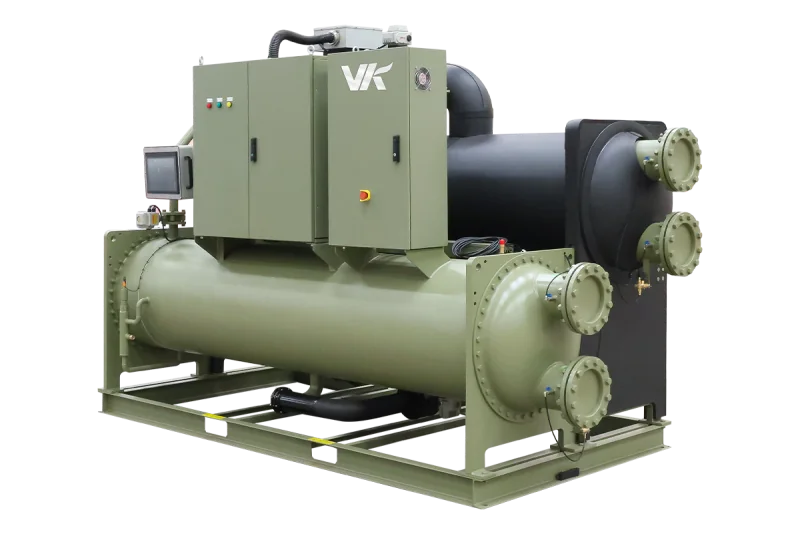
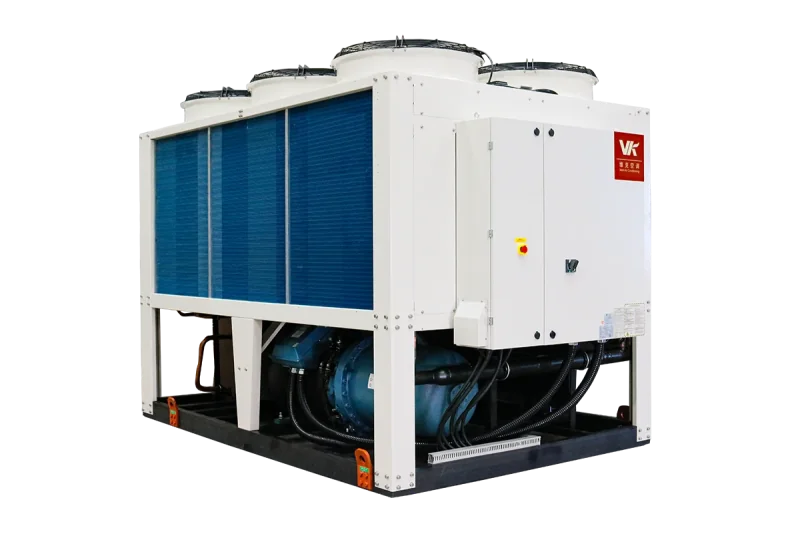
A single-machine solution uses one chiller selected for the complete design load. It may be a large air-cooled unit or a water-cooled chiller connected to a cooling tower. One machine can still contain several compressors and refrigerant circuits and therefore provide several capacity stages.
A packaged chiller is normally simpler to connect because it has one hydraulic connection point, one main power section and one control system. However, a serious failure of a common component can stop all cooling production.
Chiller cascade and partial load
Maximum building load occurs for only a limited number of hours each year. Nights, shoulder seasons and partial occupancy require much less cooling. The comparison should therefore include the annual load profile as well as the design peak.
A chiller cascade can keep one or two units operating and stop the remaining modules. The active units operate closer to an efficient load instead of forcing one oversized machine to remain near minimum capacity. The advantage depends on compressor type and control logic because a modern inverter chiller can also perform efficiently at partial load.
Chiller redundancy
Chiller redundancy is one of the main benefits of a modular arrangement. If one module fails or is taken out of service, the remaining units continue operating. The facility loses only part of its capacity instead of the complete cooling system.
Data centers, healthcare facilities and continuous production sites often use an N+1 arrangement. If three units are needed for the design load, four are installed. The controller rotates the operating and standby modules to balance their running hours.
A single-machine system can also be redundant by installing a second full-size chiller. Reliability is high, but cost, footprint and installed electrical capacity increase.
Parallel connection of chillers
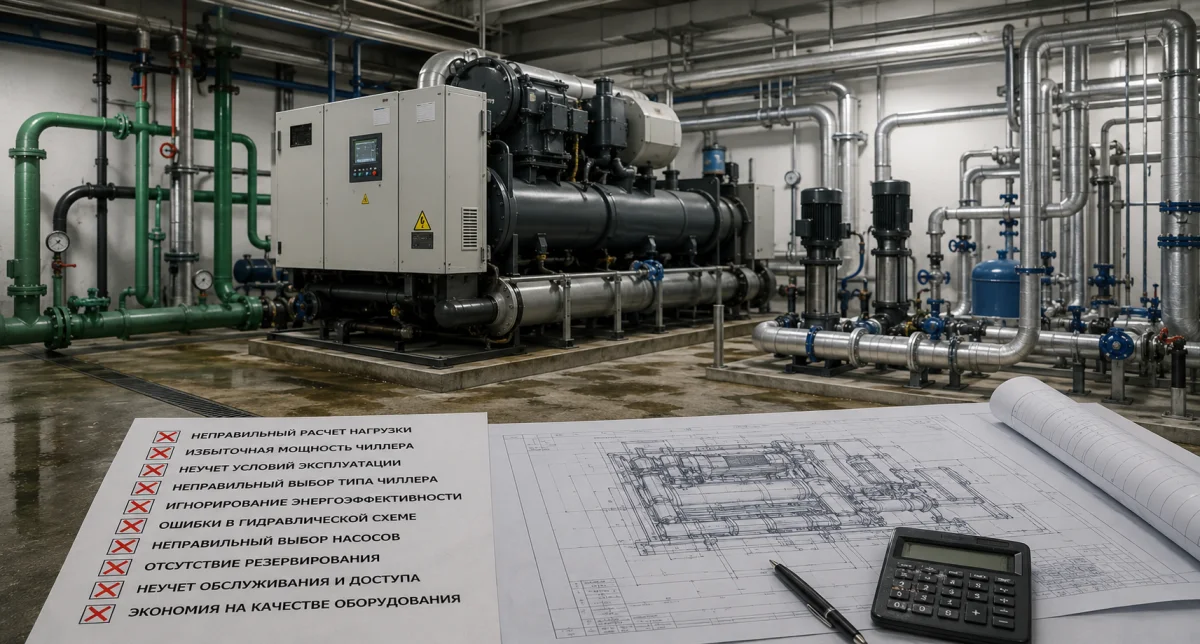
Parallel connection of chillers requires accurate hydraulic design. Each operating module must receive the required water flow, while a stopped machine must not create unwanted bypass flow. Motorized valves, check valves, balancing, dedicated pumps or a regulated common pump circuit are used.
Projects may use primary-secondary pumping, hydraulic separators or variable primary flow where approved by the manufacturer. Incorrect piping can cause low flow, unstable leaving-water temperature, freeze alarms and excessive pump energy.
Modular-system controls
The master controller should consider supply and return temperatures, current demand, minimum compressor run time, restart delay, alarms and operating hours. Enabling modules from one temperature setting alone often creates frequent switching.
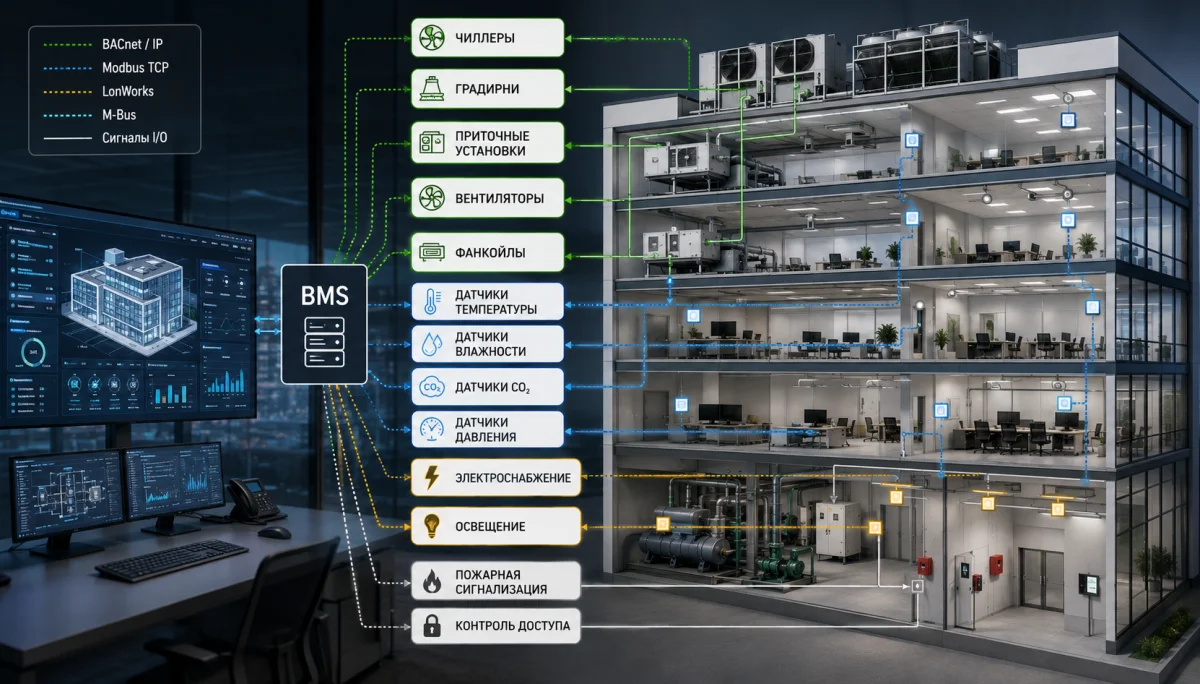
Correct controls select the optimum number of machines, add the next module smoothly and rotate operating priority. BMS integration provides monitoring of each chiller, pumps, valves, electrical demand and alarm signals.
Energy efficiency
A modular arrangement is not automatically more efficient. Performance depends on module size, minimum capacity, compressor type, outdoor temperature and water-temperature schedule. Too many small units increase the number of fans, pumps, valves and auxiliary consumers.
One large chiller may have a better full-load EER, while a cascade may consume less at partial load. A valid comparison uses annual energy consumption for the complete system, including pumps, cooling towers, fans and controls.
Footprint and installation
One central cooling machine usually occupies less total space and requires fewer connections. A large unit, however, can be difficult to transport, lift to a roof or move into an existing plant room.
Modules are smaller and can be installed in stages. They still require service clearances and sufficient airflow. Air-cooled chillers must be positioned to prevent hot-air recirculation and to account for parapets, snow and prevailing wind.
Electrical supply
Several chillers start sequentially and divide the load among separate feeders, reducing simultaneous starting current. The trade-off is a larger number of cables, breakers, panels and control signals.
One large chiller requires fewer connections but may place higher demands on the electrical service and transformer. Designers should verify nominal and starting current, protection selectivity and backup-power requirements.
Maintenance and repair
A modular system allows one unit to be serviced without stopping all cooling. Smaller compressors and fans may be easier to replace, and identical modules can use standardized spare parts. The total number of components requiring inspection is higher.
A single machine has fewer controllers, valves and connection points. However, failure of the common evaporator, main power section or central controller can stop the whole facility. Service availability, spare parts and acceptable recovery time must be considered.
Cost and future expansion
One large chiller is often less expensive per kilowatt of cooling and requires fewer installation materials. A modular arrangement may cost more because of multiple units, valves, cables and cascade controls.
Modular equipment can also increase capacity in stages. The first phase may install only part of the final system while headers, pumps, electrical capacity and space are prepared for future units. Expansion must be planned because a new chiller must remain compatible in water flow and control.
When to select a modular chiller
- the load changes significantly during the year;
- cooling cannot be completely interrupted;
- N+1 redundancy is required;
- future capacity growth is planned;
- delivery of one large machine is difficult;
- maintenance must be performed without a shutdown.
When one central machine is preferable
- the load is relatively stable;
- a scheduled cooling shutdown is acceptable;
- space and the number of connections are limited;
- the chiller has a wide modulation range;
- minimum initial cost is important;
- a separate backup system already exists.
Conclusion
A modular chiller is selected for flexibility, redundancy, variable-load operation and future expansion. One central cooling machine offers simplicity, a smaller footprint and often a lower initial cost. The best solution depends on minimum and maximum load, reliability requirements, installation conditions, hydraulics and total cost of ownership. NIKLAND engineers calculate cascades, select chillers and design controls for each building or industrial facility.