Ventilation filter classes describe particle-capture efficiency and airflow resistance. A weak filter allows contamination through, while an unnecessarily restrictive filter reduces airflow and increases fan energy.
Most buildings use prefiltration and a main filter. HEPA is required only where indoor cleanliness or a technical process justifies high-efficiency removal.
Modern filter classification
General ventilation filters are classified by efficiency for PM10, PM2.5 and PM1 particle fractions. Common groups are ISO Coarse, ePM10, ePM2.5 and ePM1. The percentage shown with the group represents declared performance for the relevant fraction under standardized test conditions.
Older projects may still use G, M and F designations. There is no universal one-to-one conversion. Replacement should compare particle efficiency, initial pressure drop, dimensions and test data rather than matching letters only.
What PM10, PM2.5 and PM1 mean
PM10 includes much road, construction and soil dust. PM2.5 contains finer particles that can penetrate further into the respiratory system. PM1 represents still smaller aerosols associated with smoke, combustion and urban pollution.
An ePM1 filter targets finer particles more effectively than a filter focused mainly on PM10. Class must still be considered together with airflow, pressure loss and frame sealing. Air bypassing the media through gaps is not filtered.
Coarse and fine air filtration
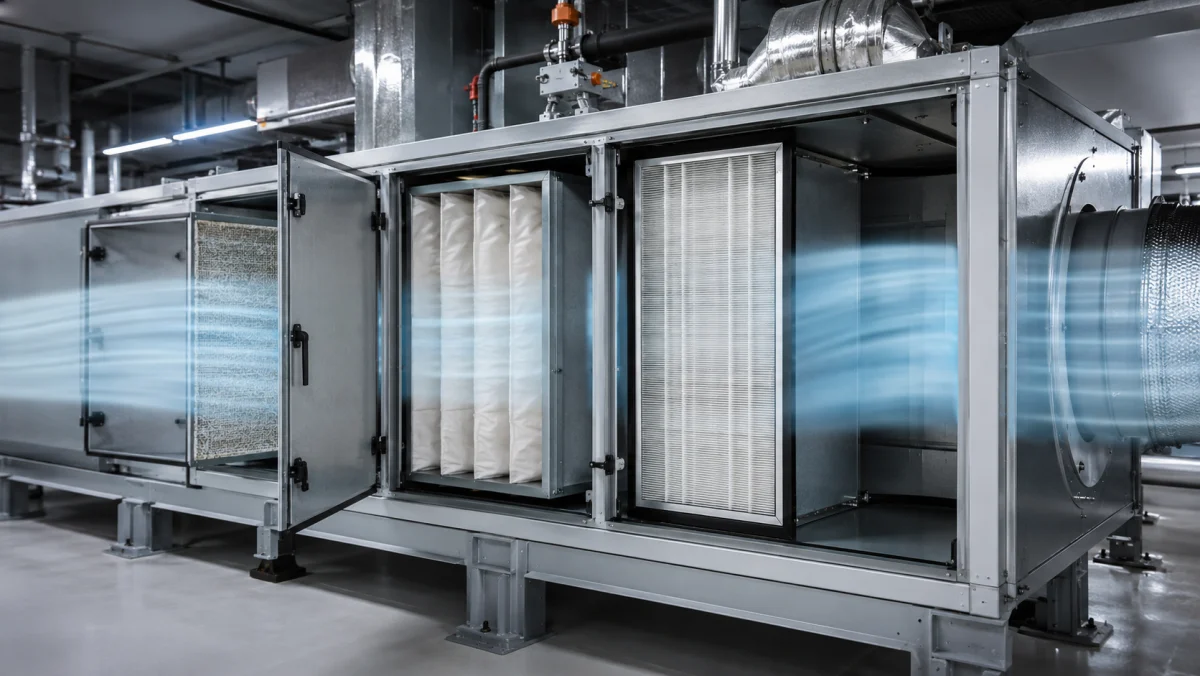
Coarse and fine air filtration serve different functions. A prefilter captures fibers, insects and large dust and protects downstream filters, coils and internal surfaces.
A fine filter removes smaller particles. Without prefiltration at a dusty site, it loads rapidly and creates high resistance. Staged filtration is normally more reliable and economical.
Filters for supply ventilation
Filters for supply ventilation are selected from outdoor-air quality and building function. An office beside a busy road needs stronger fine-particle protection than a warehouse in a relatively clean location. Indoor requirements and equipment sensitivity also matter.
A typical arrangement includes a prefilter and an ePM10, ePM2.5 or ePM1 main stage. The fan must deliver design airflow with filters at expected operating resistance, not only when they are clean.
ePM10 filters
ePM10 filters capture a significant portion of coarse and medium atmospheric dust. They may be the main stage in moderately demanding spaces or an intermediate stage before a more efficient filter.
This level may suit warehouses, technical rooms and some industrial areas. Urban offices often require better PM2.5 or PM1 efficiency.
ePM2.5 and ePM1 filters
ePM2.5 and ePM1 filters target fine particles. They are relevant to offices, hotels, schools, healthcare buildings and sites near roads or industrial areas.
A denser filter should not simply replace the original element in the same frame. If the fan lacks pressure reserve, airflow falls. An upgrade should check fan duty, controls, sealing and permitted final pressure drop.
HEPA filters for ventilation
A HEPA filter for ventilation is used in cleanrooms, operating rooms, laboratories, pharmaceutical production and selected technical processes. HEPA classification and testing differ from general ventilation filters.
Upstream filtration is essential because coarse and fine dust would shorten HEPA service life. The HEPA stage is installed in the unit or close to the clean zone.
High media efficiency alone does not guarantee performance. Frame sealing, correct clamping and element integrity are equally important, and critical installations may require leakage testing.
Filter pressure drop
Even a clean filter creates resistance, which increases as dust accumulates. The fan must provide sufficient pressure, and controls should monitor differential pressure. Excessive resistance reduces airflow or increases fan load.
Selection should compare class, initial pressure drop and recommended final pressure drop at design airflow. A larger media area often loads more slowly and may reduce lifecycle cost.
Ventilation filter replacement
Ventilation filter replacement should not depend only on a calendar interval. Differential pressure, visible condition, actual dust loading and site requirements are better indicators. Filters near construction work or during dusty seasons may load much faster.
The unit should be stopped, the frame cleaned and the gasket checked. The new element is installed in the correct airflow direction without gaps. Healthcare and technical sites may require controlled packaging, transport and disposal.
Common mistakes
- selecting only by an old G or F designation;
- installing HEPA without prefiltration;
- raising efficiency without checking fan pressure;
- operating beyond final pressure-drop limits;
- allowing bypass leakage around the frame;
- selecting carbon media without contaminant analysis;
- checking too rarely during dusty periods.
Choosing filters for a project
Offices normally need prefiltration and an effective fine-particle stage, especially near traffic. Retail projects consider outdoor dust, visitor flow and equipment cleanliness. Industrial selection depends on process contaminants and local extraction.
Healthcare, pharmaceutical and clean technical spaces require dedicated design, staged filtration and sealing control. A higher class is not automatically better: the filter must match the entire ventilation system.
Correct sizing and sealing remain essential.
Conclusion
Ventilation filter classes are selected from particle size, outdoor-air quality, room function and unit capability. Most buildings benefit from a prefilter followed by an ePM10, ePM2.5 or ePM1 main filter. HEPA is used only where justified. NIKLAND engineers select filtration according to airflow, pressure loss and operating conditions.