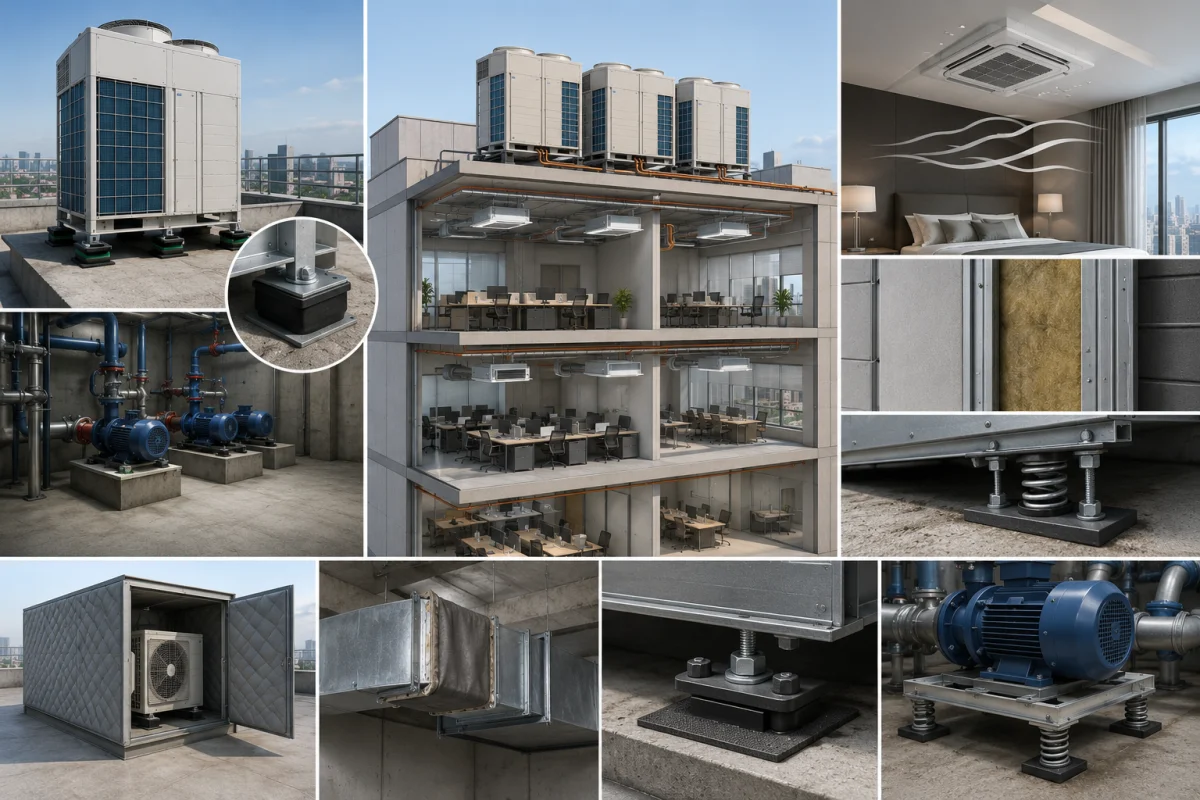
HVAC equipment noise affects not only occupant comfort but also the normal operation of offices, hotels, healthcare facilities, residential complexes and industrial buildings. The problem may come from airborne noise, structure-borne vibration, duct turbulence and vibration transmitted through piping.
Noise control should be included at the design stage. If equipment is installed first and acoustic problems are addressed later, costs usually increase because supports, duct sections, foundations, outdoor-unit positions or acoustic screens may need to be changed.
Main sources of noise
Compressors create mechanical vibration and low-frequency hum. Fans generate aerodynamic noise, which increases when air velocity is high, an impeller is dirty or the fan operates in an unstable part of its curve. Pumps transmit vibration to piping, while sheet-metal ducts can resonate.
- compressors in chillers, heat pumps and outdoor units;
- axial and centrifugal fans;
- pump groups and control valves;
- vibration of casings and metal panels;
- turbulence at bends, grilles and dampers;
- rigid connections to building structures.
How noise travels through a building
Airborne noise moves through ducts, shafts, openings and gaps in building elements. Structure-borne noise travels through floors, walls, pipes and steel frames. Equipment may be far from a room while its hum remains audible because vibration is transmitted through a rigid path.
Low frequencies are especially difficult to control. Thin acoustic lining can absorb medium and high frequencies but has little effect on compressor vibration. Low-frequency control depends more on foundation mass, correctly selected isolators and the removal of rigid bridges.
Chiller vibration isolation
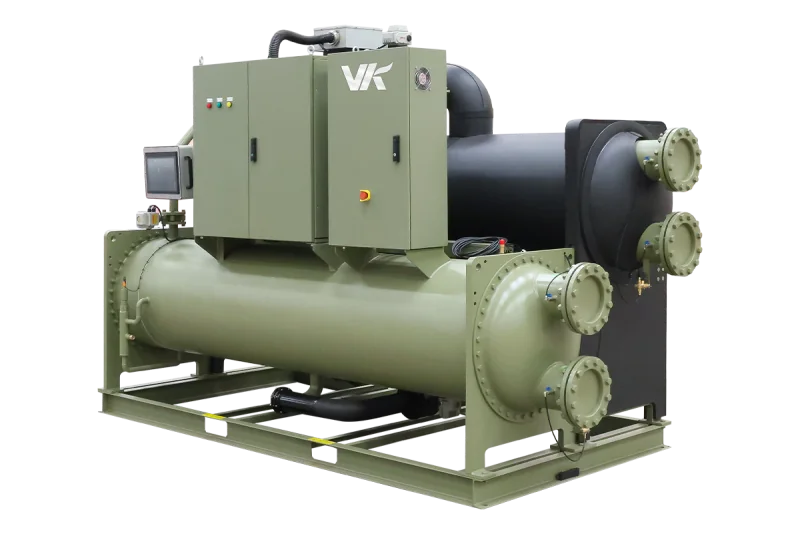
Chiller vibration isolation begins with unit mass, compressor and fan rotational frequencies, foundation type and allowable isolator deflection. Isolators should not be selected only by appearance or maximum load. A support that is too stiff provides little isolation, while one that is too soft allows excessive movement.
Rubber, rubber-metal or spring isolators are used for chillers. Spring isolators are more effective at low frequencies but require accurate selection and a stable foundation. On roofs and technical floors, an inertia base is often used to distribute mass and reduce vibration transmission to the slab.
Vibration mounts and flexible connections
Vibration mounts should be selected from the actual load at every support point. Equipment weight is rarely distributed perfectly evenly, so identical mounts at all corners may not operate correctly. After installation, deflection, level and any contact between the casing and rigid structures should be checked.
Correct mounts will not work if pipes, cable trays or drains form a rigid bridge. Flexible connectors, expansion joints and properly supported pipe sections are required. Supports after the flexible connection must carry the load without transferring it back to the unit.
Ventilation noise
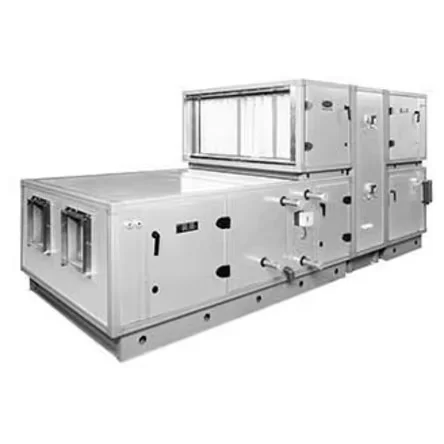
Ventilation noise is created by the fan, ductwork, control dampers, grilles and diffusers. A common mistake is reducing duct size to save space. Air velocity rises, pressure loss increases, dampers operate more heavily throttled and the system begins to whistle or hum.
Noise is reduced by limiting air velocity, using smooth transitions, larger bend radii and correctly selected terminals. The fan should operate in a stable part of its characteristic. Operation at very low or excessive airflow increases turbulence, motor load and sound level.
Duct silencers
Duct silencers are installed after fans, before noise-sensitive rooms and where acoustic transmission between zones must be interrupted. Splitter and circular silencers are common. They are selected by required attenuation, frequency range, airflow and allowable pressure loss.
A silencer that is too short has little effect at low frequencies, while narrow air passages add resistance and create their own aerodynamic noise. A straight duct section or flow-equalizing element before the silencer helps provide uniform inlet airflow.
Duct connections and hangers
A flexible connector between the fan and duct reduces vibration transfer into the network. It should not be stretched, twisted or used to correct poor installation geometry. The duct after the connector must be supported independently from the equipment casing.
Duct hangers in sensitive areas may include vibration-isolating elements. Metal ductwork should not contact walls or slabs rigidly. Penetrations should use resilient filling while maintaining the acoustic performance of the partition.
Reducing outdoor-unit noise
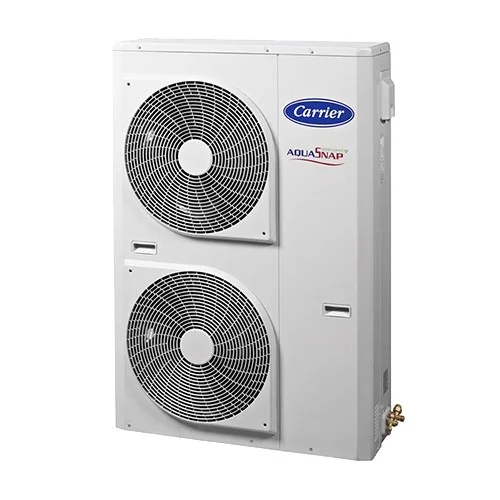
Outdoor-unit noise reduction starts with correct placement. A unit should not be installed in a closed recess where sound is repeatedly reflected and hot discharge air returns to the inlet. Distance to windows, nearby buildings, terraces, courtyards and site boundaries must be considered.
An acoustic screen should block direct line of sight between the source and the protected area without restricting airflow. A screen that is too close or fully sealed can reduce condenser airflow, increase pressure and force fans to run faster, making the noise worse.
How acoustic calculations are performed
Calculations use equipment sound-power data by octave band, distance to the receiver, source directivity, surface reflections and the sound insulation of building elements. Several sources are combined logarithmically: two identical units increase the total level by about 3 dB.
For a ventilation network, the calculation includes fan noise, attenuation along ducts, bends, branches, silencers, terminals and noise generated by airflow itself. The result is compared with the allowable level for the room type and time of day.
Checks during installation and commissioning
- load and deflection of every vibration isolator;
- absence of rigid casing contact with the foundation;
- condition of flexible connectors and expansion joints;
- fan and pump balance;
- air velocity at ducts and terminals;
- operation at different capacity stages;
- absence of panel and access-door rattling;
- comparison of measured and calculated noise levels.
Common mistakes
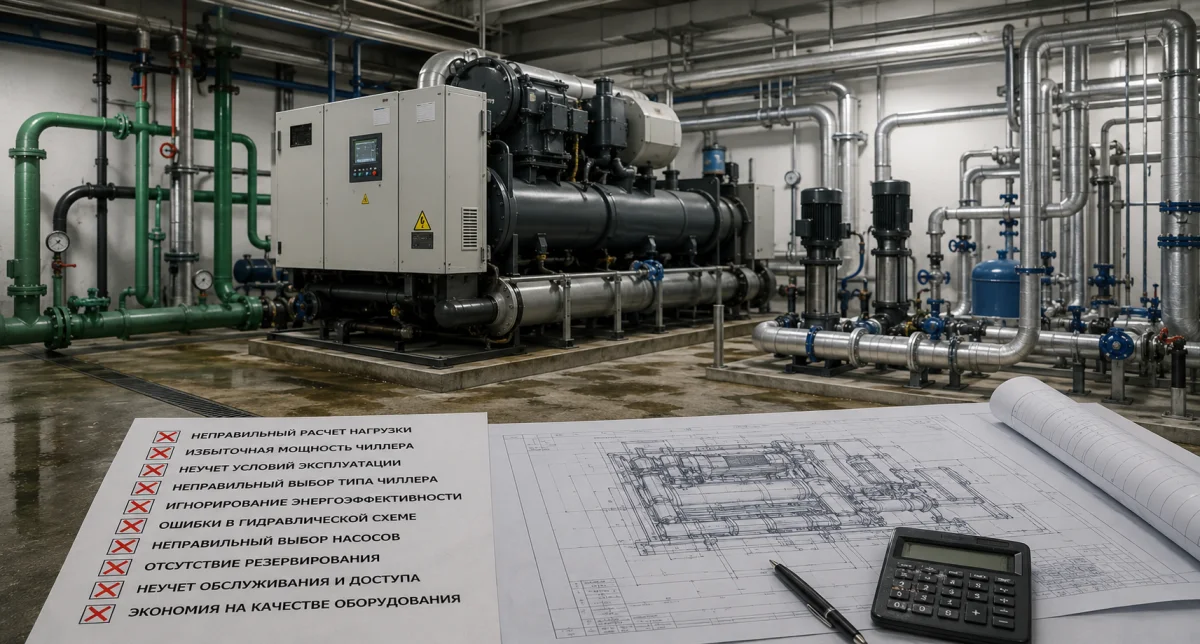
Common mistakes include placing equipment directly on the slab, using random rubber pads, rigidly connecting pipes, undersizing ducts, omitting silencers and locating outdoor units opposite windows. Another mistake is trying to solve structure-borne vibration only with acoustic wool.
Effective noise reduction requires work on the source, transmission path and protected room. If only one element is treated, the remaining transmission paths may preserve the problem.
Conclusion
Reducing HVAC equipment noise requires correct equipment selection, reasonable air and water velocities, vibration mounts, flexible connections, duct silencers and appropriate placement. Chillers need a suitable foundation and vibration isolation, ventilation systems need good aerodynamics, and outdoor units need adequate distance, discharge direction and acoustic screening. NIKLAND engineers consider acoustics during HVAC design and select solutions for reducing noise and vibration in commercial and industrial facilities.