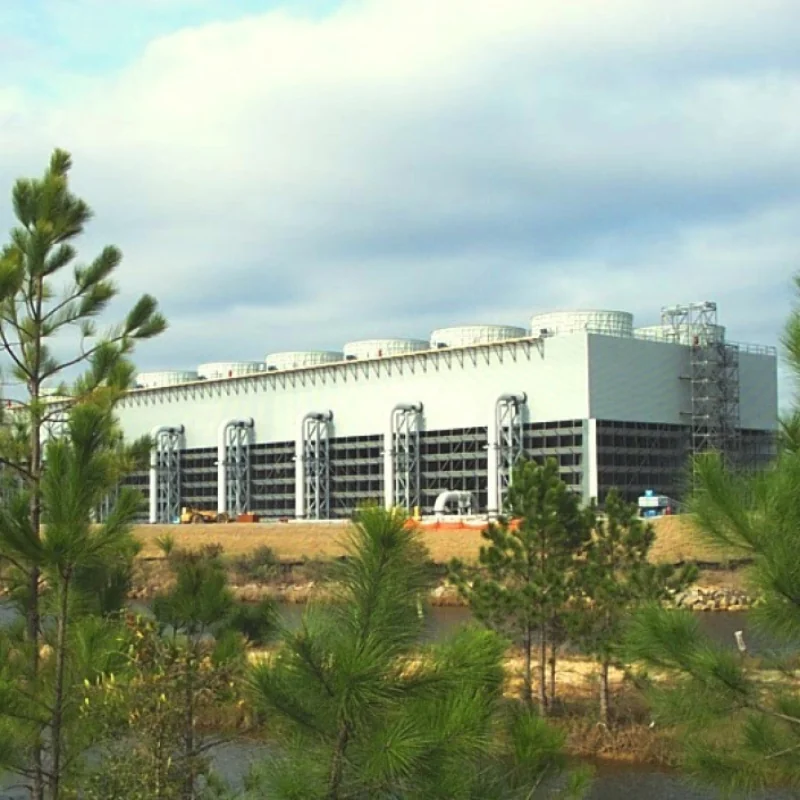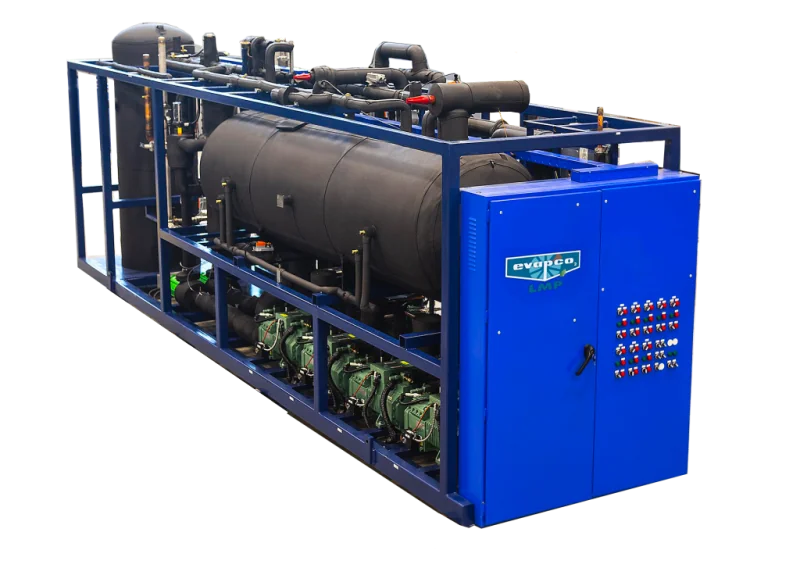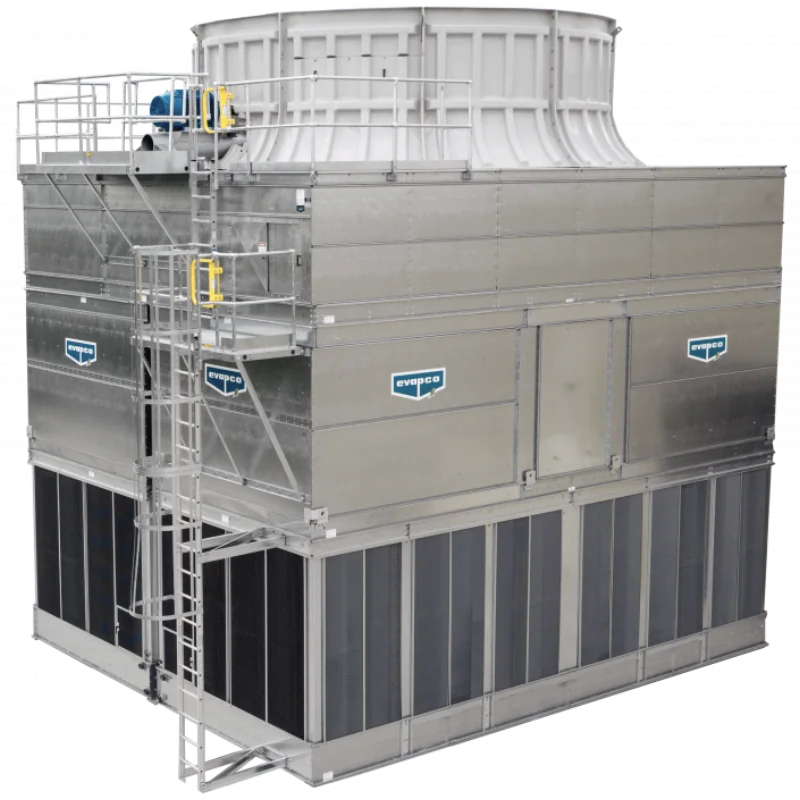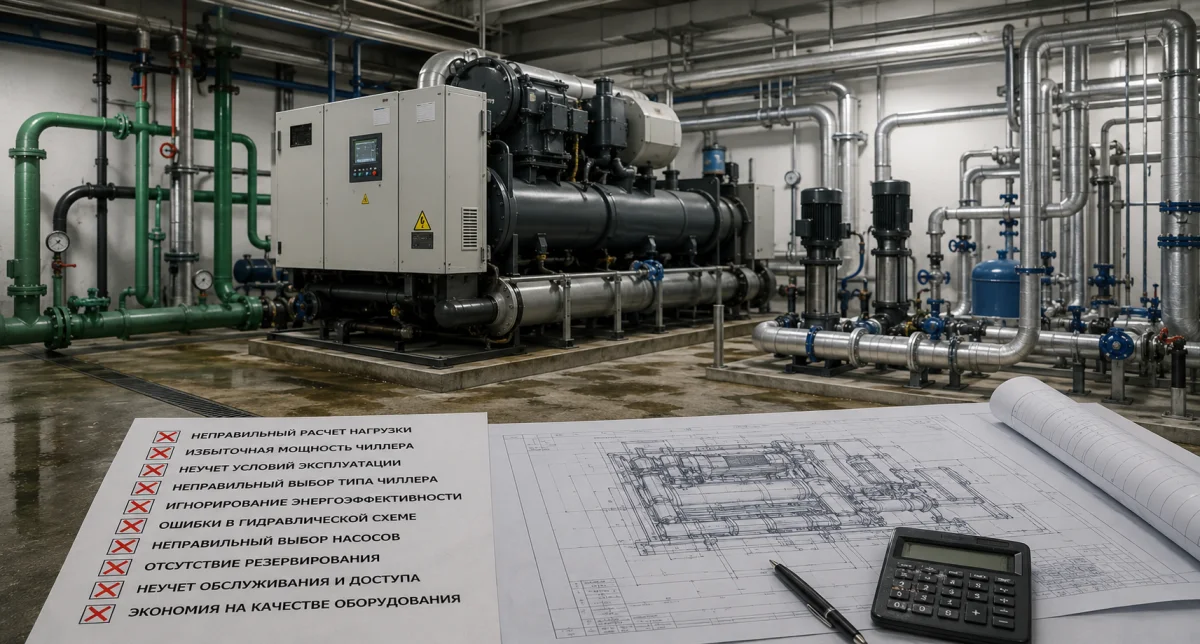
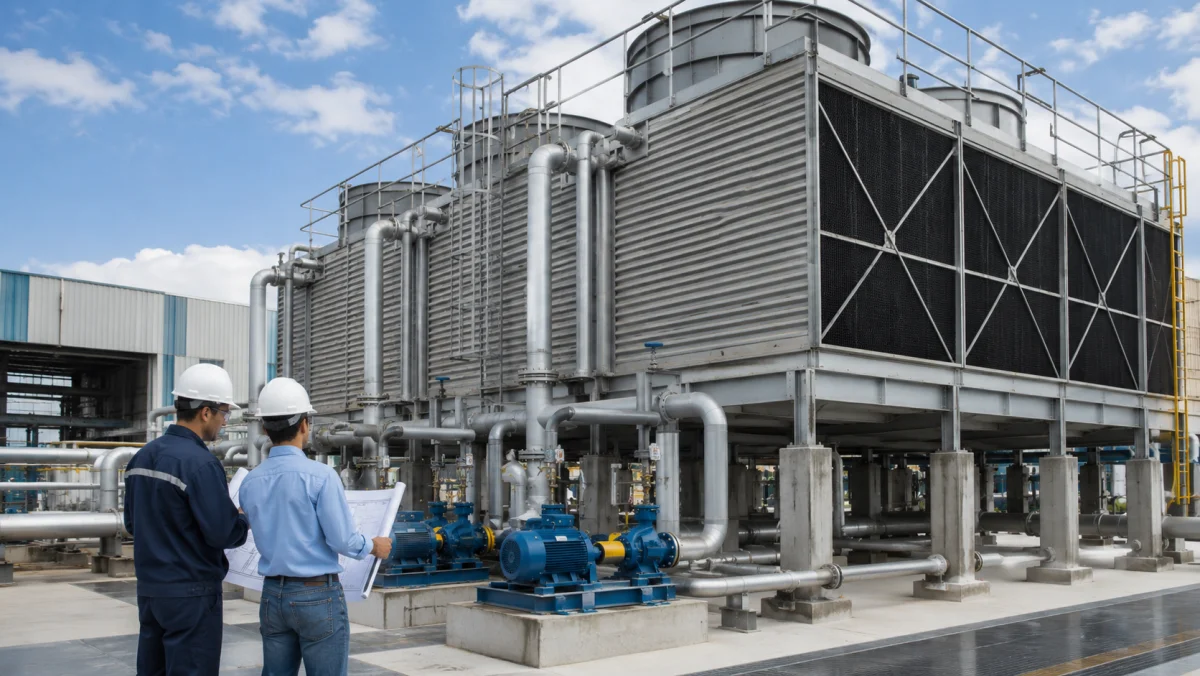
Cooling tower calculation determines whether equipment can reject the required heat under actual site conditions. Nominal capacity alone is unreliable because performance depends on water flow and temperatures, wet bulb, humidity, altitude and operating mode.
Industrial towers must be checked for summer peak, partial load and winter operation.
Required input data
The calculation needs heat load, water flow, entering and leaving temperatures, design wet bulb, water quality, schedule and redundancy. Space, sound, elevation, wind and plume restrictions are also checked. Chiller data comes from the condenser loop, while process data comes from equipment heat output.
Cooling tower heat load
The cooling tower heat load is the heat removed from circulating water. In a chiller system it exceeds cooling capacity because it includes the process or building load plus compressor input power.
If a chiller provides 1000 kW of cooling and consumes 250 kW, the tower load is approximately 1250 kW. Final values should be taken from equipment data at design conditions.
Cooling tower capacity
Cooling tower capacity cannot be described by kilowatts alone. The same tower rejects different heat loads at different water and air conditions. Higher entering-water temperature and lower wet bulb make heat rejection easier.
A supplier therefore needs heat load, entering and leaving water temperatures, design wet bulb and water flow. This complete operating point defines the real selection.
Cooling tower water flow
Cooling tower water flow is linked to heat load and water-temperature difference. A larger temperature difference requires less flow for the same heat transfer, but it must remain compatible with the chiller or process equipment.
A preliminary energy balance multiplies water flow, specific heat and temperature difference. Final selection should be verified by manufacturer software.
Cooling range
The difference between entering hot-water temperature and leaving cold-water temperature is the cooling range. If water enters at 35 °C and leaves at 30 °C, the range is 5 °C.
A larger range reduces required flow but may increase demands on heat exchangers and controls. A smaller range needs more flow, larger pipes and more pump power.
Wet-bulb temperature
Wet-bulb temperature is the main climate parameter for an evaporative cooling tower. It combines air temperature and humidity and indicates the air’s ability to absorb moisture.
A cooling tower cannot cool water below wet bulb. The closer the required leaving-water temperature is to that value, the larger and more expensive the tower becomes. Site-specific climate data should be used instead of average dry-bulb temperature.
Approach to wet bulb
The difference between leaving-water temperature and wet-bulb temperature is called approach. If leaving water is 29 °C and wet bulb is 25 °C, approach is 4 °C.
A small approach requires more fill area, airflow and effective heat transfer. Reducing leaving-water temperature by only a few degrees can significantly increase tower size and cost.
Cooling tower selection
Cooling tower selection uses the complete operating point. Manufacturer software applies heat load, flow, water temperatures and wet bulb to determine the model, number of cells, fan configuration and duty.
Capacity margin should be reasonable. Excessive oversizing increases cost and footprint and may make winter control difficult. Multiple cells or variable-speed fans normally provide better turndown.
Open and closed-circuit towers
In an open tower, water contacts air directly, providing high efficiency but requiring water treatment. In a closed-circuit tower, process fluid remains inside a coil, protecting the main loop but increasing cost and reducing thermal efficiency.
Evaporation, drift and blowdown
Water is lost through evaporation, drift and blowdown. Total makeup demand must be included in water-supply design to prevent low basin levels and excessive mineral concentration.
Tower location
Location must prevent recirculation of warm humid air. Walls, nearby buildings, wind and cell spacing affect inlet conditions. Sound, vibration, operating weight, service access and plume entry into ventilation intakes must also be checked.
Winter operation
Winter operation requires a separate strategy. Cold air increases heat-rejection capability but creates icing risk on fill, louvers, basin and fans. Controls may use water bypass, reduced fan speed, cell isolation and basin heating.
The tower must maintain a safe minimum water temperature and prevent ice formation.
Redundancy
Continuous processes may require N+1 capacity or several cells. Remaining equipment must carry the required load at maximum design wet bulb, not only during favorable weather.
Common mistakes
- selecting only by nominal kilowatt capacity;
- using dry-bulb instead of wet-bulb temperature;
- ignoring approach to wet bulb;
- omitting evaporation, drift and blowdown;
- allowing warm-air recirculation;
- providing no winter operating strategy;
- ignoring water chemistry and materials.
Calculation sequence
- determine heat-rejection load;
- define entering and leaving water temperatures;
- calculate water flow;
- select design wet-bulb temperature;
- determine range and approach;
- select tower type and number of cells;
- check water demand, sound and location;
- verify summer, winter and standby operation.
Selection report and documentation
The final report should record the selected operating point, corrected capacity, fan power, water losses, sound data and all climate assumptions. This makes later comparison, commissioning and maintenance much easier.
Conclusion
Cooling tower calculation is based on heat load, water flow and temperatures, wet-bulb temperature and site conditions. Correct selection checks summer peak, partial load, winter operation, water quality and redundancy. NIKLAND engineers select cooling towers for chiller plants and industrial systems according to Kazakhstan climate and actual project requirements.