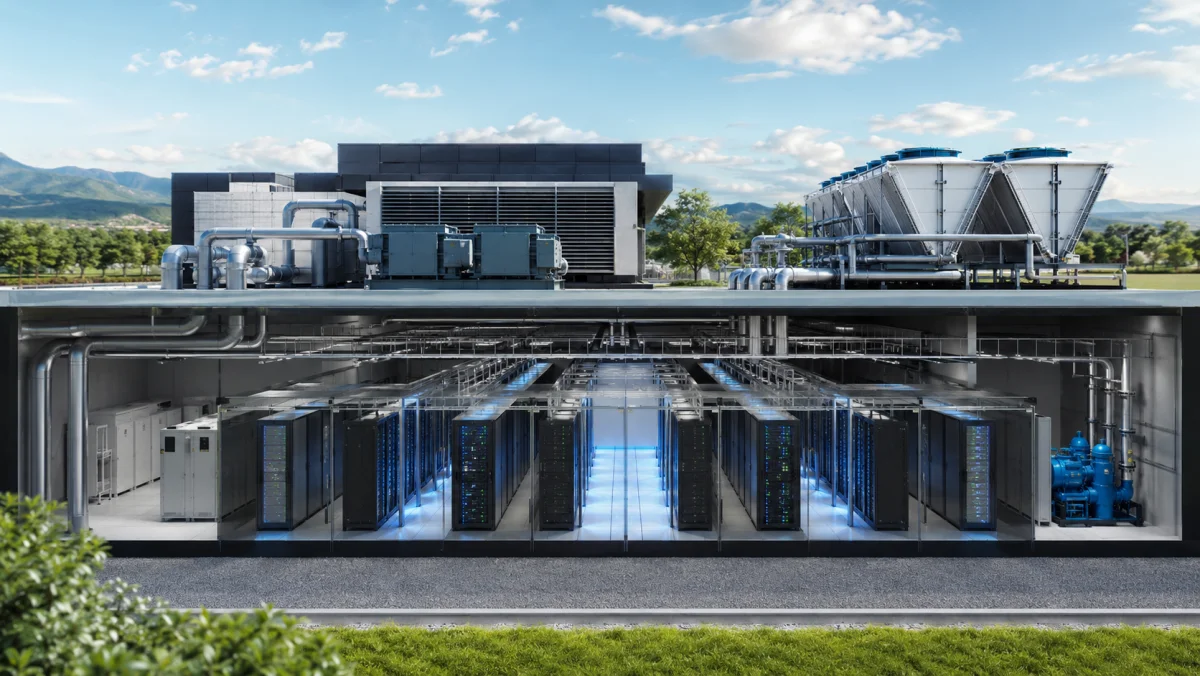
Free cooling for data centers uses low outdoor temperature to remove server heat with minimal compressor operation. Because data centers require cooling throughout the year, free cooling can reduce infrastructure energy consumption and improve PUE.
Free cooling does not always mean bringing outdoor air directly into the server room. Direct-air, indirect-air, water-side and hybrid systems are available, with mechanical refrigeration operating only when outdoor conditions or load require it.
What PUE means
PUE is the ratio of total data-center energy to the energy used by IT equipment. A value closer to one means that less power is consumed by cooling, UPS losses, lighting, pumps and other supporting systems.
PUE reduction requires more than efficient chillers. Hot- and cold-aisle containment, supply temperature, fan speed, pump operation and control sequences all influence the result. Free cooling is most valuable when climate and operating temperatures allow long compressor-free operation.
Direct-air free cooling
In a direct system, filtered outdoor air enters the server space and warm return air is exhausted. Compressor cooling starts only when outdoor temperature, humidity or air quality falls outside the permitted range.
The main advantage is high efficiency with few intermediate heat exchangers. Limitations include dust, smoke, humidity, corrosion risk and the need for reliable filtration, damper control and room-pressure management.
Indirect-air free cooling
Indirect systems keep outdoor and indoor air streams separate. A plate, rotary or other air-to-air heat exchanger transfers heat from recirculated server air to the outdoor stream.
This protects IT equipment from outside contaminants. The additional exchanger and fan pressure, however, reduce the temperature advantage and may shorten the annual full-free-cooling period.
Water-side free cooling
Data-center free cooling is often integrated with chilled-water precision cooling. During cold weather, water or glycol is cooled in a dry cooler and supplied to room units without running chiller compressors.
During transitional conditions, partial free cooling pre-cools the fluid while the compressor provides the remaining duty. This saves energy even when outdoor temperature is not low enough for full free cooling.
Evaporative and adiabatic cooling
Adiabatic cooling reduces outdoor-air temperature before the heat exchanger and extends compressor-free operation. It is especially effective in dry climates.
Design must consider water use, water treatment, hygiene, biological control and maintenance. Electrical savings should be compared with water and service costs.
When free cooling is most effective
Potential depends on outdoor temperature, required supply conditions and the permitted server-room envelope. Higher allowable air or water temperatures increase the number of free-cooling hours.
In water systems, return temperature also matters. Higher return-water temperature improves dry-cooler performance but must remain compatible with precision units, CDU systems and other cooling terminals.
Airflow management
Before adding cooling capacity, hot and cold air mixing should be reduced. Aisle containment, blanking panels, sealed cable openings and correctly placed supply grilles reduce recirculation.
Higher return-air temperature improves heat-exchanger performance, extends free-cooling hours and can reduce fan speed.
Fans, pumps and controls
Even with compressors off, fans and pumps can consume substantial energy. Variable-speed control should maintain required airflow and pressure instead of running constantly at maximum speed.
Controls may respond to cold-aisle temperature, differential pressure, rack load and return-water temperature. Poor sequences can cause free cooling and compressor cooling to operate together unnecessarily.
Redundancy and reliability
Energy savings must not reduce resilience. Critical data centers require the specified N+1 or other redundancy arrangement, with standby pumps, fans, heat exchangers and mechanical cooling capacity.
During smoke, outdoor pollution, extreme humidity or a free-cooling fault, the system must return automatically to a safe mode. These transitions should be tested during commissioning and periodic drills.
Estimating data-center energy savings
Data-center energy savings should be calculated from hourly climate data, IT load and equipment performance. Minimum winter temperature alone does not describe the benefit. The model should identify hours of full free cooling, partial free cooling and compressor operation.
Compressor, fan, pump, humidification, heating and water-treatment energy must be included. Annual consumption, capital cost and maintenance are then compared with the baseline system.
How free cooling affects PUE
Reducing compressor operation lowers cooling energy, but actual PUE also depends on IT utilization. At low IT load, fixed UPS, fan and pump losses form a larger percentage of total consumption.
The design should therefore be assessed at current load and future expansion. An efficient system should maintain good performance across several loading scenarios.
Common mistakes
- selecting a system without hourly climate analysis;
- maintaining an unnecessarily low server-room temperature;
- ignoring fan and pump energy;
- poor hot- and cold-aisle containment;
- insufficient filtration for direct outdoor air;
- ignoring water use in adiabatic systems;
- providing no backup mechanical cooling;
- poor control transitions between operating modes.
Design sequence
- define current and future IT load;
- collect hourly temperature and humidity data;
- select allowable air or water conditions;
- compare direct, indirect and water-side options;
- calculate full and partial free-cooling capacity;
- verify redundancy and emergency modes;
- model annual energy consumption and PUE;
- develop control sequences and testing procedures.
Conclusion
Free cooling for data centers reduces compressor energy and can improve PUE, but performance depends on climate, supply temperature, airflow management and controls. The best solution combines free and mechanical cooling, variable-speed operation and reliable redundancy. NIKLAND designs energy-efficient cooling for data centers and server rooms according to IT load, Kazakhstan climate and resilience requirements.