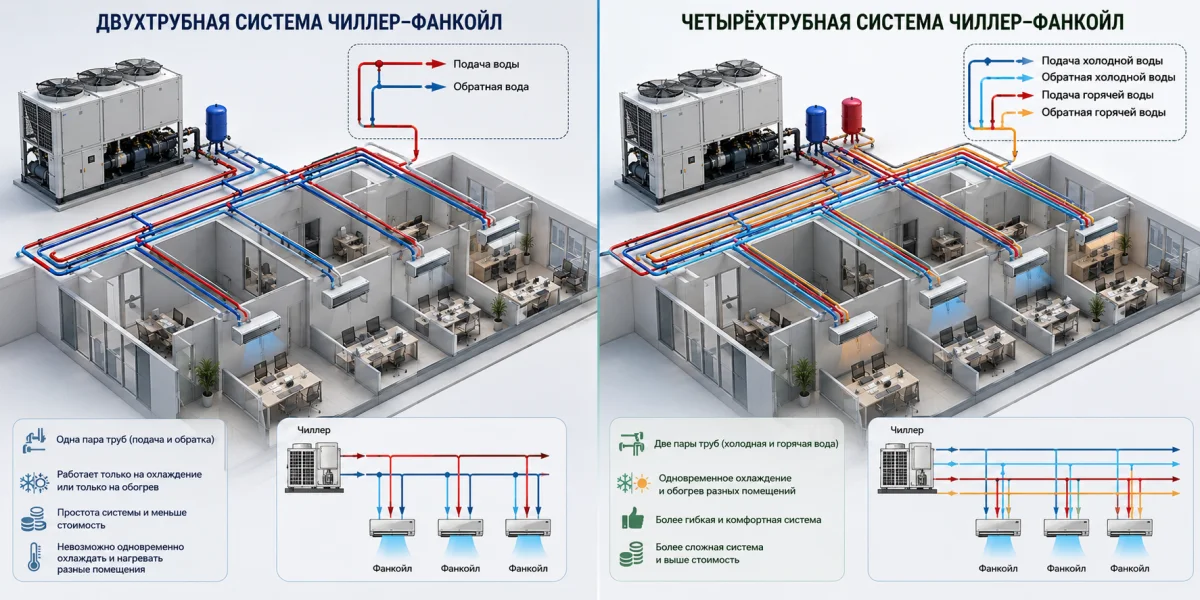
Two-pipe and four-pipe fan coil systems are two ways to distribute chilled and hot water in a chiller–fan coil installation. The main difference is the number of pipes and whether some rooms can cool while others heat at the same time.
A two-pipe arrangement is simpler and less expensive because the same supply and return lines carry either chilled or hot water depending on season. A four-pipe system uses two independent circuits and allows each zone to select its own mode.
How a chiller–fan coil system works
A chiller produces chilled water, pumps circulate it through the building and fan coils transfer cooling to room air. Heating water may come from a boiler, heat exchanger, heat pump or reversible chiller.
The fan coil itself does not generate cooling or heat. Its output depends on water temperature, flow, fan speed, coil condition and correct hydronic balancing.
What a two-pipe fan coil is
A two-pipe fan coil has one coil with a supply and return connection. Chilled water flows through it in summer and hot water in winter. All units on the same circuit use one seasonal mode.
Occupants may adjust setpoint and fan speed or switch the unit off, but they cannot request heating while the circuit is operating with chilled water.
What a four-pipe fan coil is
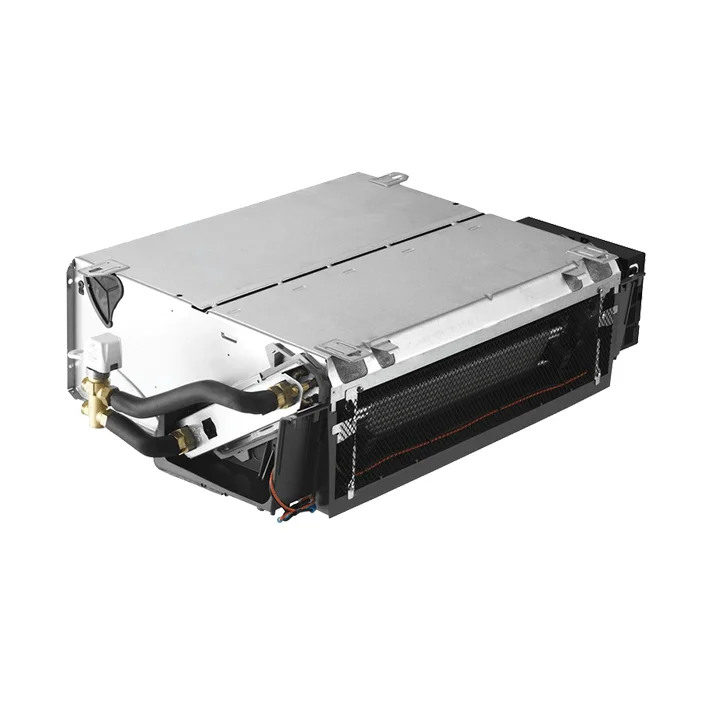
A four-pipe fan coil has two separate coils. One is connected to chilled water and the other to hot water. Each coil has a supply and return connection.
The controller opens the appropriate valve according to room temperature. One zone can therefore cool while another heats at the same time.
Main differences
| Parameter | Two-pipe | Four-pipe |
|---|---|---|
| Water pipes | Two | Four |
| Heat exchangers | One | Two |
| Simultaneous cooling and heating | No | Yes |
| Installation cost | Lower | Higher |
| Zone flexibility | Limited | High |
Advantages of a two-pipe system
- fewer pipes, valves and insulation;
- lower equipment and installation cost;
- simpler hydraulic design and controls;
- less shaft and ceiling space;
- good suitability for one seasonal mode.
This arrangement suits small offices, shops, schools, warehouses and buildings where most rooms require cooling or heating at the same time.
Limitations of two-pipe systems
The main limitation is the lack of independent mode selection. During spring and autumn, sunny rooms may need cooling while shaded rooms need heating. A two-pipe circuit cannot provide both simultaneously.
Seasonal changeover affects the whole circuit. Switching too early or too late may cause discomfort in part of the building.
Advantages of a four-pipe system
- independent mode selection by zone;
- simultaneous building cooling and heating;
- better comfort during transitional seasons;
- good suitability for hotels, hospitals and offices;
- flexibility for different façades and schedules.
Heating with fan coils can operate while server rooms, conference rooms or high-load spaces continue cooling.
Limitations of four-pipe systems
A four-pipe arrangement requires more piping, valves, insulation, pumps and installation space. Fan coils with two heat exchangers are normally larger and more expensive.
Controls are also more complex. Hot- and chilled-water valves must be coordinated, and simultaneous flow through both coils must be prevented.
Fan coil connection diagram
A fan coil connection diagram includes supply and return pipes, control and balancing valves, strainers, air vents, drainage and controls. Each unit should be isolated for service without stopping the complete system.
A two-pipe unit uses one valve on its single coil. A four-pipe unit uses separate valves for the chilled- and hot-water coils.
Hydraulic calculation
Pipe sizes are selected from water flow, velocity and pressure loss. Pump head and balancing valves are then calculated. Low flow reduces fan coil output, while excessive flow increases noise and pump energy.
A four-pipe design requires separate calculations for chilled- and hot-water circuits because their temperatures, flows and pressure losses differ.
Fan coil capacity selection
Unit capacity follows the cooling and heating load of each room. Performance must be checked at actual water temperatures, flow and fan speed rather than nominal catalog conditions only.
For a four-pipe unit, both coils are verified separately. Cooling covers solar, occupancy and equipment gains, while heating covers room heat loss.
Controls
The room controller operates the fan and valve. In a two-pipe system, it must know the current seasonal mode and water temperature.
In a four-pipe system, the controller selects the cooling or heating coil. A dead band between modes prevents rapid switching.
Energy efficiency
Two-pipe systems have lower initial cost and fewer pumping circuits. However, some buildings may need electric heaters or separate air conditioners during transitional weather.
Four-pipe systems maintain two circuits but deliver heating or cooling only where required. Efficiency depends on variable-speed pumps, water temperatures, controls and balancing.
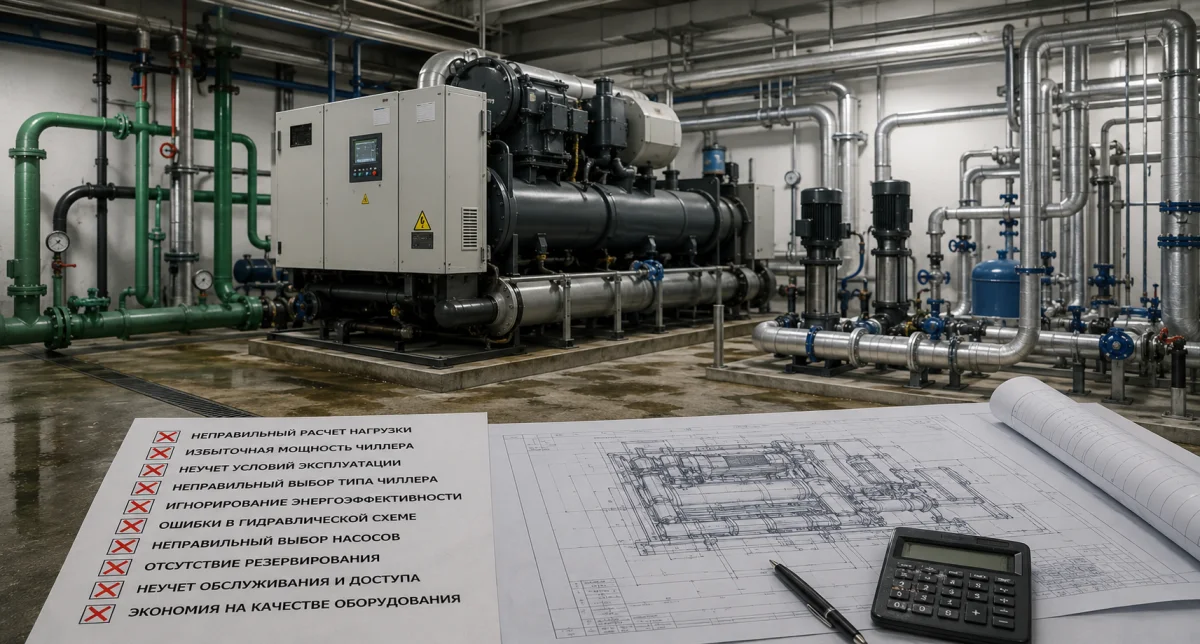
Common mistakes
- selecting two-pipe without analyzing transitional-season loads;
- failing to balance branches;
- incorrect valve and actuator selection;
- insufficient chilled-water pipe insulation;
- poor service access;
- sizing only from room area.
How to choose
Selection begins with building function, façade orientation, operating schedule, zone quantity and user expectations. If opposite loads are rare and seasonal changeover is acceptable, two-pipe is normally more economical.
When building cooling and heating are regularly required at the same time, four-pipe offers more stable comfort. The final decision should compare annual operating modes, capital cost, energy use and maintenance requirements.
Conclusion
Two-pipe and four-pipe fan coil systems differ in both piping and climate-control capability. Two-pipe is simpler and less expensive, while four-pipe provides independent cooling and heating by zone. NIKLAND engineers calculate and design chiller–fan coil systems according to room loads, hydraulics, controls and Kazakhstan climate conditions.