
Redundant operation
N+1, 2N and other redundancy schemes maintain cooling during maintenance or equipment failure.
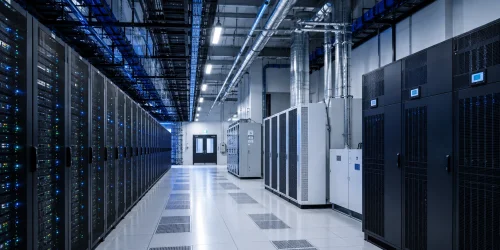
Design, supply, installation and maintenance of reliable cooling systems for data centers, server rooms, telecom facilities and critical IT infrastructure.
Request a project estimate →Data centers require stable temperature, controlled humidity, predictable airflow and redundancy. NIKLAND designs cooling around actual rack density, UPS load, expansion plans and nonstop operation.
N+1, 2N and other redundancy schemes maintain cooling during maintenance or equipment failure.
Hot- and cold-aisle containment reduces mixing and prevents local hot spots.
Free cooling, variable-speed equipment and accurate controls help reduce PUE.
Temperature, humidity, pressure, leaks and alarms are tracked around the clock.
Close control of temperature and humidity for server rooms and machine halls.
View equipment →Central chilled-water systems with redundancy and free-cooling capability.
View equipment →High-density cooling for modern racks and computing clusters.
View equipment →Equipment sequencing, alarms, leak detection and integration with DCIM or BMS.
View equipment →We review rack density, UPS capacity, room layout, redundancy and expansion plans.
We calculate capacity, airflow, hydraulics, containment and control sequences.
We coordinate equipment, piping, containment, commissioning and documentation.
We maintain systems, verify redundancy and restore operating parameters.
Data centers and server rooms impose requirements that differ fundamentally from ordinary commercial properties. The objective is not occupant comfort but continuous heat removal from racks, UPS systems, power distribution and network equipment. NIKLAND calculates the system around rack density, redundancy, allowable temperature ranges, hot- and cold-aisle containment, raised floors and nonstop operation. Depending on capacity, the solution may include precision air conditioners, chillers, dry
coolers, free cooling, in-row cooling and liquid cooling loops. Monitoring covers temperature, humidity, pressure, leaks and alarms, while automation transfers load to standby equipment. This approach helps data centers in Kazakhstan maintain stable conditions, reduce PUE and minimize overheating risk.
NIKLAND’s engineering approach to data centers begins with an assessment of the current and projected IT load, rack density, UPS capacity, equipment layout and required redundancy level. For facilities in Aktobe, cooling capacity is calculated separately for server halls, electrical rooms, UPS areas, network zones and technical spaces. Airflow modelling is used to identify hot spots, prevent mixing of hot and cold air and determine the most effective arrangement of aisles, raised floors, overhead supply and return paths. Depending on the facility scale, the solution may include precision air conditioners, chillers, dry coolers, free cooling, in-row systems, rear-door heat exchangers or liquid cooling circuits. The final configuration is selected with regard to outdoor conditions, available power, noise limits, maintenance access and future expansion. During installation, special attention is paid to aisle containment, sealing of cable openings, piping, thermal insulation, drainage, leak detection, hydraulic balancing and commissioning under real load. Control algorithms provide automatic staging, reserve changeover and continuous monitoring of temperature, humidity, pressure and equipment status. After handover, NIKLAND performs scheduled maintenance, diagnostics, coil cleaning, filter replacement, sensor checks, automation testing and restoration of design parameters. This approach helps data centers maintain stable conditions, reduce overheating risks, improve energy efficiency and support uninterrupted growth of the IT infrastructure.
Submit a request — our engineers will contact you within 24 hours and suggest a solution for your facility.